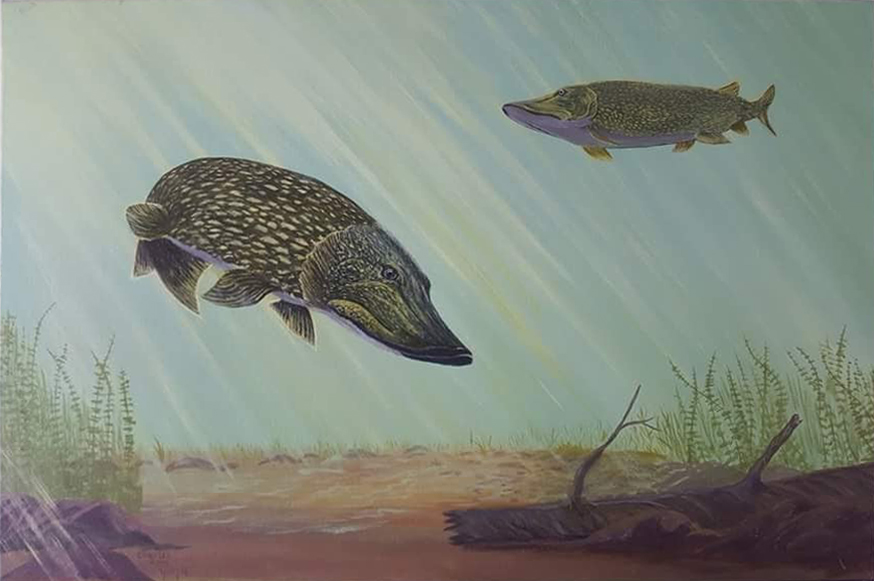
Les Moberly, Untitled, 2019. Acrylic on canvas. © Les Moberly (Les’s Trapline Art)
The Spirit in the Art of Les Moberly
By Harmony Johnson-Harder
Molanosa, a name formed from the first two letters of each word in Montreal Lake, Northern Saskatchewan, is more than just a dot on the map. Nestled in the geographic centre of Saskatchewan, it holds a quiet power and deep meaning for many. It was here that an adhesion to Treaty 6 was signed, and until the 1970s, a vibrant community thrived. Indigenous and non-Indigenous trappers, hunters, and fishers lived, worked, and raised families together.
When the provincial government redirected services across the lake to the new highway, residents were forced to relocate to Weyakwin or La Ronge. The community was dissolved, but the spirit of the place remained.
I am a descendant of this community. My grandmother came to Molanosa with her parents after First Nations families were displaced from the newly established Prince Albert National Park. She raised her ten children here with her Swedish husband — a wandering soul who led a crew of Doukhobors who cut and built the original road to La Ronge.
Most families in Molanosa were of mixed descent — Woodland Cree women and European men. Many Cree women had lost their Indian status and were unable to live on reserve, and their children were denied the same Treaty rights and land-use rights as their cousins on the reserve until the 1980s and 2000s through Bill C-31 and Bill C-3, when their mothers and grandmothers regained status.
My father, born and raised in the community, made sure we returned to Molanosa at least once a year — to his home, where he took his first steps, spoke his first words, and read his first book. His love for this place became mine. Though I never saw Molanosa at its peak, I have felt the creative spirit it nurtured. Living off the land cultivated imagination — the kind that shapes musicians, writers, crafters, beadworkers, and visual artists. There is a magic here. A magic our ancestors left for us in the land.
This story is about one of those Molanosa artists, Les Moberly.
The Making of the Artist
Descendants of the original families continue to return to Molanosa today, building off-grid cabins and shacks in the bush. The longing for reconnection with the magic of Molanosa is powerful. That same longing lives in Les Moberly, a multidisciplinary artist whose creative voice and personal peace are rooted in the sands and waters of Molanosa.
Les also goes by Charles Ross to carry forward the spirit of and to honour his grandmother Jeannie Ross, who was a respected medicine woman and midwife. Jeannie was a sister to my great-grandmother, one of many children of Elizabeth and James Ross, whose legacy is greater than they probably imagined as we move into its seventh generation.
Much like many people who lived in Molanosa, Les moved away as a boy. In the 1970s, the provincial government told most of the people they were disconnecting services to the isolated town and moving everything across the lake to the new community of Weyakwin. Over the years, Les lived between Weyakwin, La Ronge, and Prince Albert, working as a guide in northern fly-in fishing camps. He always returned to the land and made a guiding career out of the knowledge that Molanosa taught him. Eventually, he returned home to live out his life in an off-grid in a hand-built cabin. He simply says, “I’m gonna stay till the end, I imagine.”
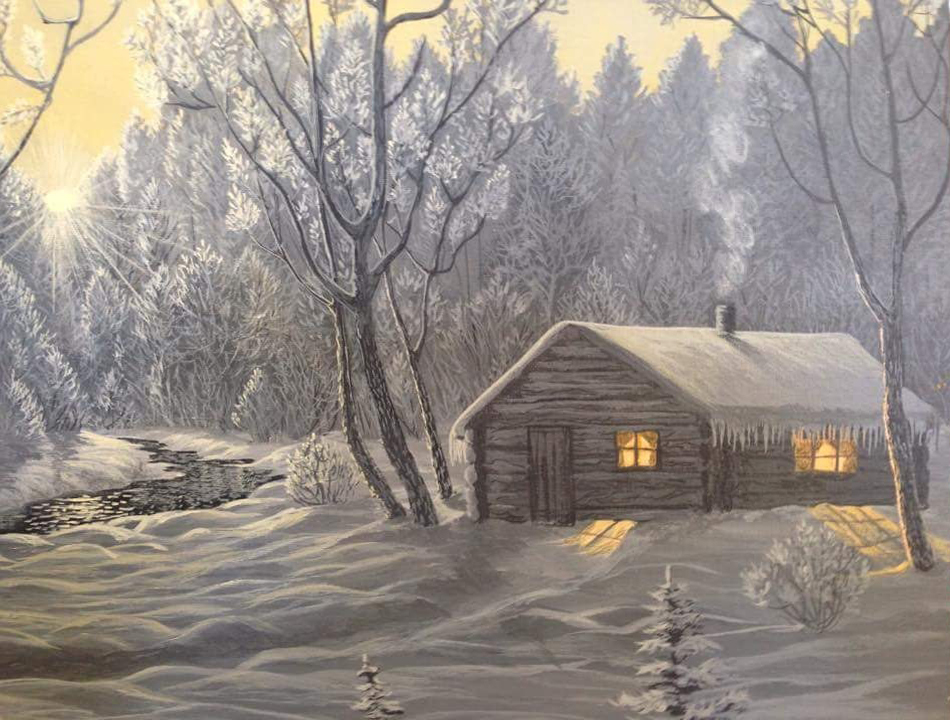
Les Moberly, Untitled, 2019. Acrylic on canvas. © Les Moberly (Les’s Trapline Art)
The Artist and His Work
Les is a self-taught, interdisciplinary artist with a preference for painting. Though he has worked in watercolour and moose-antler carving, he always returns to acrylics. “Oils,” he laughs, “take too long to dry.”
His art is defined by and grounded in lived imagery of cabins, nets, fish, and memories from the trapline. His love for the land is evident in his paintings. He told me that the water calls to him, that as a child he would sit by the lake for hours, mesmerized by how the light danced across the ripples. That connection guided his life, first as a fishing guide, later as an artist capturing that spark of light in his work.
He began painting in 1985 and describes that as the moment he “found his voice.” Art came naturally to him. As a boy, he was often scolded in school for drawing in his textbooks instead of doing homework, but that urge to create never left him. Painting, for Les, is a type of therapy. Art is a language for his spirit and feelings that words can’t express. It brings peace and keeps him in balance.
“Every painting tells a story,” he says. “Your happiness and pain are in that painting. You leave part of yourself behind in every one.”
As we talked, I learned he teaches art at local schools and had the opportunity to collaborate on a mural with Jackie Traverse in Montreal Lake. He is committed to sharing not only his skills as a trapper and guide, but also as a skilled painter with the community.
I asked him what advice he would give to young artists. He shared that youth need to find their creative voices: “Just paint what you see, or if you’re feeling down, grab a pencil or paper just to get your mind off feeling down. I’ll start painting, and that usually works for me.”
Moberly calls his practice Trapline Art, what I would describe it as a visual documentation of the Woodland Cree way of being. His art captures our stories and landscapes in a way that his paintings become more than art, they are acts of remembering. An expression of his love for the land, his ancestors, his grandmother, and the elders who showed him how to live in balance with the land.
As I visited with Les and learned how much inspiration he takes from his surroundings, I asked him, “What is the land saying to you? How does it influence your art?” His reply was,
“Respect the land, the water, the trees, the seasons. I was told never to play with the water or nature. If you abuse it, it will come back at you.” From what I know of Les, he lives this rule everyday, and he shares it by example with the youth who come to learn from him.
Les is more than a trapper, fisherman, and artist — he carries a deeper kind of knowledge, the kind taught by land, spirit, instinct, ancestors, and the quiet creative voice inside him. Thank you les, for reminding me that my creativity comes from Molanosa, and it’s important to return home.
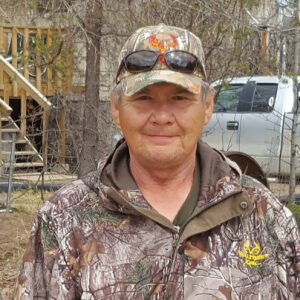 Charles “Les Moberly” Ross known as Les, is a self-taught multidisciplinary artist whose Trapline Art reflects the landscapes, stories, and rhythms of Northern Saskatchewan. Born near Molanosa, a historic Treaty 6 community, he grew up immersed in trapline life, guiding fish camps and moving between Weyakwin, La Ronge, and Prince Albert. Today he lives off-grid in a hand-built cabin, painting primarily in acrylics to capture cabins, nets, fish, and reflections on water, blending memory, emotion, and environmental observation. For Moberly, art is both medicine and record, preserving the legacy of his ancestors and the spirit of Molanosa, offering viewers a story of connection, place, and homecoming.
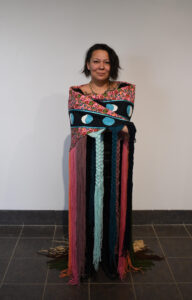 Harmony Johnson-Harder is a storyteller, artist, and creative visionary inspired by the land, her grandmother, her father, and Woodland Cree & Metis culture. Harmony’s work celebrates culture, connection, and shared humanity.
A multidisciplinary artist, her modern beadwork, mixed-media painting, and 3D art combine traditional Indigenous techniques with experimental materials. Her storytelling workshops inspire curiosity and connection, creating spaces where participants explore themes of land, symbolism, and ancestry.
Harmony participated as a mentee through CARFAC SK Art Writing Mentorship Program and also has written for Vacation Land News, A local newsletter. She is a producer and writer for Stories of the North, which was nominated for an award at the Yorkton Film Festival in 2023 and 24. She is currently collaborating with the University of Saskatchewan College of Medicine on research projects exploring mental health and arts and culture interventions in First Nations communities. Harmony has served as a traveling storyteller, and has led numerous arts and storytelling workshops in local and Northern communities. She was also a presenter at The Art of Visiting, an artist gathering in Kingston, Ontario.
Harmony is passionate about the arts, culture, and sharing that passion to inspire others to transform their own stories. Through her work, she embodies the transformative power of creativity and connection, while continuing to grow and develop her own artistic practice.
Photo credit, Lana Wilson, Mann Art Gallery, Shawl Made by Harmony Johnson-Harder Strawberry Moon, as part of the “Moon is our Grandmother” art project 2023