Cinema as the Beast Is the Demise of Contemporaneity

Svetlana Romanova, Season of Dying Water, 2015/2022, video still. Courtesy of the artist and Chelsea Tuggle
by Svetlana Romanova
The Republic of Sakha (Yakutia) is situated in the Far Eastern region of Russia. It is home to several Indigenous groups, including the Sakha people. While “Yakut” was the term historically imposed through Russian colonial administration, “Sakha” is the self-designated name and is increasingly recognized as the preferred term. The name “Yakutia” is still used on a state level to refer to the broader multi-ethnic territory of the republic, encompassing all communities living within its borders.
Yakutian cinema: umbrella term to talk about all the films made in and outside of Yakutia
Sakha cinema: visual culture created by Sakha people, Subarctic context
Even cinema: visual culture created by Even people, Arctic context
What does an image mean in Sakha and Eveny cultures? The immensity of this question haunts me, including in my own work. An image can mean so many things, depending on its contextual placement. Image production can be a historical moment that transforms the perception of a culture (like the formation of the Republic of Sakha in 1991 and state production company Sakhafilm in 1992), or it could be a historic visual form (petroglyphs) that now equates to the visual representation of the culture. Images’ meanings are never tied to visuality or materiality only, but rather found in the crevasses, informed by and contained in time. Those images permeate through the spaces, leaving an aftertaste. Perhaps the question we should be asking ourselves is: what makes those images Sakha or Eveny? How do we count authorship and intent?
~The Othering~
Russia’s geographic placement, where the power centre aims to constantly prove its relation to Europe (the West), while the rest is perceived and treated as Northeast Asia, is essential to understanding its internal politics. By dissecting its own territory into variants of geopolitical weight, the empire manages to act out its complicated past (fear of Asianness) through the implementation of governing divisions like regions, republics, and peripheries. The fragmentation of our land can be broken into three territories: Siberia (a cultural imaginary), an umbrella concept for the regions that reside within North Russia; Republic of Sakha (Yakutia), a “self-governed” region with seven Indigenous groups residing in Subarctic and Arctic territories; and Far East, a broader geographic territory that fits all of Northeast Asia (not restricted to Russia). These divisions are tied by imaginaries that feed the needs of the receiving end—for example, externally, Siberia regionally places the perspective of one in the West as an association to the North; internally, Siberia as a territory holds very little value, with no adjacent cultural ties, and is often used in tourism to maintain the myth of its “remoteness.” The internal politics of Russia are rarely visible in the international context, but rather the territories are presented as pre-packaged and resource-filled, with growing ties to Northeast Asia. This representation is also a product of economic imagination. Racialization of these territories through the disregard of the Indigenous population, who has struggled for visibility and distinction, compromises their sovereignty as an ethnicity. Yellow peril as a belief and political stance was instrumentalized by Russia, as a part of Europe, in the late-19th century [1] as a form of outlived, harshened fear of constant Asian vanquish (Genghis and Orda Khan, wars with Japan, etc.), but also as a strategy to other its own Indigenous population, specifically of the Far East and Arctic.
~Punctures in Time~
Image production forms specific senses of communality. The propagated state of friendliness of annexed nations asserted by Soviet visual representation, which I would like to tag as lens exotica, was a vigorous machine that the state used to alter the understanding of belonging. Belonging to a nation, belonging to society, belonging to the state. The identitarian crisis was resolved through a belief that all of the residents of the Soviet Union, regardless of their cultural specificity, were now within a certain hegemonic harmony under the pretense of “united nations.” However, the dissemination of this idea was conveyed through mass cultural production, specifically cinema, which highlighted each individual ethnos by showcasing their assimilation into the industrialized world. The Soviet propaganda worked so well in glorifying the erasure of the inherent aesthetics of Yakutia, and discombobulating the populus into thinking that they do belong, that their belonging was contingent on their performance of “Russian collectivity.” Like that, Soviet time can be marked as exemplary of the birth of “community,” as deformations in the perception and performances of that word have been elongated in the current state of late capitalism.
~Colonial Time Is Contemporaneity~
The past, or some would say history, is usually measured from the perspective of “discovery.” The point of ascension (awakening, coming to being) of a culture is defined by its contact with settlers. This perverse entitlement of perception is usually a dominating narrative in colonial states, where the ongoing processes of the same instrument of power remain in stasis. When “discovering” Yakutia, imperiality extracted our knowledge through the destruction of our ways of being by developing the concept of “republic,” and established the “Arctic” as a place and territory. With this act, the state erased the original ontologies of a place that are transmitted through people—referred to as aesthetics, ways of perceiving life. Now, the state extracts the actual matter (resources and minerals), hollowing out the land they have narrativized into a country. If the beginning of Arctic exploration has created the fertile soil for further expansion, now its seeds of fear are in full bloom. These crops are blossoming on the cruxes of cultural voids, filling the wells of despair with prosperity. Harvested to feed the original inhabitants, these kernels have been inside us for centuries, morphing and adding to our aesthetics.
~Essence of the Dissent~
In 1957, on the shores of the Arctic Ocean, a young family welcomed their third daughter—my mother was born in Bykov Mys. Her birth marked the beginning of the Soviet turmoil that would ultimately lead to the Union’s dissolution. The ’60s marked the era of kolkhoz [2] collectivization and excessive deforestation (ongoing) in Yakutia, also as a part of broader mining research [3]. Through forced collectivization, the state came up with a scheme where workers of the mines were sustained by and dependent on produce coming from the Arctic regions. Arctic people were deployed to submit their resources (deer) for the “bigger cause.”
The Soviet collapse was not only in the change of governance, but also in the change of societal beliefs. The ’90s and early aughts were a race where rampant economic opportunities mixed with the remnants of communal ideologies, forming the era reminisced by bandit soap operas. Lens exotica rebranded into national television, which used images to form endless narratives depending on the demand. One of these leading narratives was an Arctic frontier that had become excessively militarized under the rule of the new president, Putin. Exotic images of Arctic dwellers covered in fur, smiling or going about their business, were replaced with oil barrels. The projected imaginaries of development on the thawing ice and the Republic of Sakha (Yakutia) became that of a resource colony with a high migrant working population. The visualization of our presence is always dictated by time, and rendered by the political interest that at its core is nothing but an economic imaginary.
~Exposition of Vice~
As practitioners of image production who are of Indigenous descent, we should be questioning the residual mechanisms of colonization that are ongoing in various forms. These variations are at times too tricky to expose yet, once detected, are haunting in their nature. But at what point, with respect to the complexities of the colonial past, can we say that the internal lens has been enticed by modernity? What are the threats of self-exoticization?
Internal exoticization does not always imply a set of rudimentary ridicules that are easily detected, but may suggest complex layers of violent historical past in correlation to factual realities within the state of contemporaneity. Let me present two examples in relation to the territoriality of cinema—one producing the myth and the other reacting to it:
The alleged profitability of our specific geographic location—the coldness and vastness of the Arctic. Commodifying the intrinsic aspects of our daily life is like highlighting the obvious. When you are from within the community, is the reproduction of your obvious a thing of interest? What about the allure of (commercial) cinema, which is presupposed to teleport you to unknown places and provide a glimpse into unfamiliar feelings? This constant presence of discovery, of escape, is what makes the cinema now exotic; therefore, when you repackage your mundane, you are (un)willingly self-mythologizing. Exoticization happens when the external gaze consumes the labours of your “narrativization” and deploys them against you.
Woven into the fabric of reality, the territoriality of Yakutian cinema can be viewed in its details: how culture is presented, how it represents itself, what is visible, and what is left unseen. It is necessary that the territoriality of cinema is a language that can be understood by people from the place or culture. Otherwise, cinema gets consumed with objectification and altered narrative projections.
There is an arguable urge to perform your identity when you are operating outside of your cultural context. Is that similar to putting a haryskhal [4] on your chest? Is that a method of adaptability? Did we abandon our own principles of time and, in a race with contemporaneity, outrun our nativeness and unground our films?
~In Bloom~
Reformulating and unpacking the mechanisms of colonial perception is the most important task of the cinema of the alleged peripheries of the world. Indigenous cinema, or films that come out of a very specific place—culturally or geographically tied cinema—has an inherently political lens. There are tasks, in their grit and weight, which are so staggering, so crucial, that we need to recognize ourselves as natives to our home first for our movies to be charged, not empty. For our cinema to live up to its inherited politicalness, we should embody the rigour of our own resilience, not shy away from it. Sakha and Even cinema should hold its form of relationality, through developing its own sovereign yet recognizable visual language, which mirrors the values of hereditary aesthetics—culture.
Imagine Yakutian cinema as a beast, as a being, as an animal. A beautiful deity that is crossing the frozen currents of coloniality, swiftly dismantling constructed artifices. Can you hear its roar resonating in the thawing waters of your deepest boreholes? How do we look through the eyes of the loved, trusted, forgotten? How do we see ourselves?
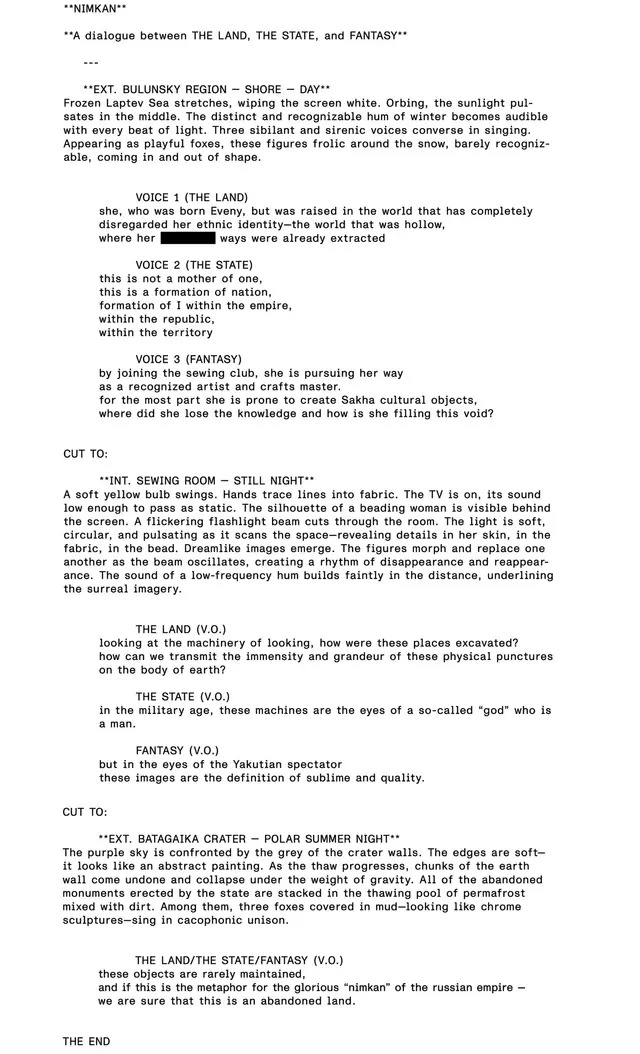
Arctic Imaginaries: Nimkan [5]
In this proposed chimeric script, I am asking you to imagine the beast, I am asking you to join me in this reverie, known as film.
Acknowledgment: This article (cinema as the beast is the demise of contemporaneity) was originally written as a submission for the Indigenous Art Writing Award (IAWA), presented by C Magazine and the Indigenous Curatorial Collective / Collectif des commissaires autochtones (ICCA). Published in C161, “Stop,” August 2025.
Indigenous Art Writing Award 2023 – Recipient: Svetlana Romanova, Runners-up: Nyssa Komorowski, Ashley Qilavaq-Savard.
Endnotes
[1] Akira Iikura, “The Precursors of the Yellow Peril Theories: Mikhail Bakunin and Charles Pearson,” RIAD Bulletin, International University of Japan, no. 3 (March 1995): 257–292, https://iuj.repo.nii.ac.jp/record/789/files/3_257-292.pdf
[2] A collective state farm in the Soviet Union.
[3] This deforestation caused a thermokarst depression and the creation of Batagaika crater. Regardless of environmental catastrophes that were known, imperial demands for riches have been ignited by the allure of minerals in the region. Endless expeditions to locate diamonds resulted in the discovery and development of the Mirnyi and Udachny diamond pipes in the 1950s.
[4] Protection talisman.
[5] The word nimkan in the Even language denotes different narrative forms of folklore: myths, heroic tales, legends, fairy tales, and more. Methods of presenting nimkan are singing, recitation, and storytelling. Nimkans had a significant influence on the formation of the worldview of the Evens: they included knowledge about the surrounding nature, the origin of the world, the history of the people, all carrying spiritual meaning.
 Svetlana Romanova (Sakha/Even) is an artist and filmmaker born in Yakutsk, the capital city of the Sakha Republic, Russia, located south of the Arctic Circle. Her practice centres on the importance of Indigenous visual language, particularly in the Arctic regions and gravitates toward critical self-historization. She received a BFA from Otis College of Art and Design (2012) and an MFA from California Institute of the Arts (2014). Her films, including Lena River (2014), Manga Bar/Rustam’s Habitat (2019), Kyusyur/Stado (2021), and Season of Dying Water (2015/2022), have been exhibited at venues around the world, including the National Art Museum of the Republic of Sakha, Moscow Museum of Modern Art, Flaherty NYC, e-flux Screening Room, Tampere Film Festival, Media City Film Festival, Goethe Institute (Montréal), Artist’s House (Yakutsk), and California Institute of the Arts, among others. She is the recipient of grants, fellowships, residencies, and awards, including “The Right To Be Cold* – Circumpolar Perspectives” Residency in Nunavik and Sápmi, supported by the Goethe Institut (Montréal); a Jan van Eyck Academie Residency (2022–2023); and a Sustainability Award from Tampere Film Festival (2022), together with Ville Koskinen, Daniela Toma, and Matti Kinnunen. She is a COUSIN collective Cycle II artist (2022–2023), supporting her forthcoming project Voyage of Jeanette, a visual essay structured around the Bulunsky district, its residents, and their traditional practices.