
Notes on Paper: Spiritual Healing for Artists and Other Humans
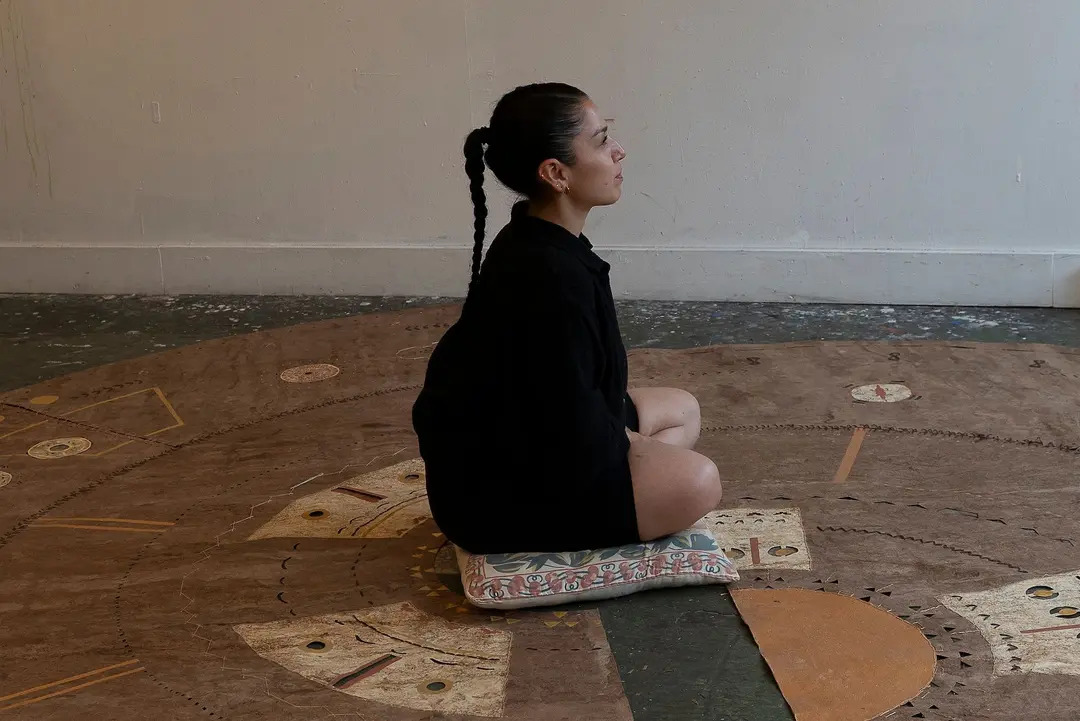
Michelle Peraza with Implictus and Incognitus Inter-Cosmologies in process, during the “i made it through the wilderness” residency on Mnisiing/Toronto Islands, 2025. Photo: Shawn Grey; Courtesy of Michelle Peraza
by Magally Zelaya
Auh ynjn amatl catca quaoamatl, amo texamatl: ynic tilaoac cenmapilli: auh ynjc patlaoac cenmatl: auh ynjc vijac cempoalmatl. (And this was a paper, white paper, not yellow paper, a finger thick, a fathom wide, and twenty fathoms long.)
—Unknown Nahua elders, scholars, and artists, The Florentine Codex, 16th century[1]
The paper heals. That’s what artist Michelle Peraza tells me about amatl—the ancient Mesoamerican paper produced from the bark of the wild fig tree. In October 2024, Peraza, then 33, opened up her tidy, amatl-strewn studio in the basement of the Art Gallery of Ontario where she was the AGO x RBC artist-in-residence.
Peraza told me that she hadn’t been herself for several months. She felt shattered, like Coyolxauhqui, the Nahua (Aztec) goddess who was beheaded and pushed down a sacred mountain where she broke into pieces. Not only had recent events in her personal life ripped her apart, but so had three back-to-back degrees, three solo shows in the last two years (and more group shows), lecturing at OCAD U, and an intensive research practice that underpins her art-making. “I’ve combusted,” Peraza said. “I reached the point this year of beyond burnout, like the spirit burned out.”
Peraza also felt bound by her previous work as an oil painter, trapped in the visual language of empire. Oil painting, with its epic durability, was for centuries the choice for depictions of Europe’s wealthy and powerful, for glorifying European military victories, for strengthening colonial tropes, and thus, for helping legitimize the conquest of land and people.
Though her last two bodies of work—hyperrealistic figurative oil paintings—subverted the medium’s power and resisted colonial history, centred her family, and celebrated Brownness, she was tired of working in a Eurocentric paradigm. That work, she said, had been fuelled by an unsustainable substance: anger. As an artist of Costa Rican and Cuban descent, fighting against a lack of Latinx representation in art, systemic oppression, and erasure had left her depleted.
When I visited her studio, there were only pencil crayons and Beam Paints, an Indigenous family-run line of handmade plant- and mineral-based pigments that she was using on reams of amatl (the Nahuatl word for paper, called amate in Spanish).
For the past five years, Peraza has been working with amatl, and she’d devoted herself to it for this residency. During the previous summer in Mexico, she had researched amatl-making and its sacred use in ritual offerings, priestly attire, and healing, along with its historical use in payment of tribute, and books (now known as codices). Later, while visiting her aunt in Costa Rica to rest, she found herself making cuts in amatl using architectural stencils. The cutting continued here in the studio, where she would spend six or seven hours a day cutting.
“The process of working with the paper became a way for me to cope and heal,” she said before expounding on amatl’s long spiritual history. “That’s why I use the bark paper. It’s a way to bring the past into the present.”
For the residency, her work on amatl mainly consisted of two large-scale drawings—one circular, one hexagonal (Cosmography, 2024–ongoing)—both inspired by the mass movement of people and plants in the colonial era, which some geologists recognize as the true start of the Anthropocene. The natural interplay of dark and light fibres in her amatl canvas subtly evoked layers of sediment. She built on the strata with tiny botanical drawings, richly pigmented lines suggesting paths, and intricate patterns of cuts. Pinned to the wall, they suggested old maps, even though neither composition had a central point: an allusion to the fact that there is no true centre to the world, and that the peripheries of the past and present aren’t fixed.
As Peraza subtracted and added to the amatl, the project took on a personal dimension. The pieces have diameters of five feet (approximately 1.5 metres), the same height as the artist. She called these works self-portraits. Both are severed in half.
*
Invented by the Indigenous peoples of what is now Mexico and Central America, amatl was widely used across the region, including by the Maya, Nahua (a broad term for speakers of Nahuatl, including the Aztec), Mixtec, and Otomi peoples. First, the bark of ficus cotinifolia and ficus petiolaris are stripped by people today called jonoteros. The strips of bark, called tira, are boiled in soda ash and lime, and then pounded with a flat volcanic rock. The tira are then laid out in a cross-hatched pattern on large screens and left to dry in the intense sun. Historically, the paper would then be coated in gesso or stucco, giving it a smooth white finish. While deer hides were also used as a writing surface, amatl has always held a special place in Mesoamerican history.
Today amatl is primarily made in the villages surrounding San Pablito, Pahuatlán, an Otomi town in central-east Mexico. There, in the rugged, difficult-to-access mountains, the Otomi people have kept amatl alive through the last 500 years of colonization. This sacred paper survived the cataclysm of massacres, famines, and plagues that we quietly call the “Spanish Conquest.” It survived Spanish colonizers’ 250-year-long Inquisition in Mexico, during the first years of which Bishop Diego de Landa mass-burned Mayan codices and presided over the torture of some 4,500 Mayas over the course of three months, part of a series of campaigns now known as the Extirpation of Idolatry.[2] Even after the Spanish Church officially exempted Indigenous people from the Inquisition, they continued to be persecuted in local ecclesiastical courts for idolatry, witchcraft, superstition, and dogmatizing against the Catholic Church.
It was under these circumstances that amatl’s spiritual and ritual use was banned. Not until the ’60s does amatl reappear in a significant way. In those days, the Otomi were the only ones who manufactured the paper and cut it into symbolic shapes and figures, which the Nahua people would then colourfully paint.[3] Today the tourism souvenir industry and pressures of forestry have changed these production dynamics, but the paper still holds a spiritual power for many of the region’s Indigenous peoples.
*
My ancestors are the Nahua people of El Salvador, site of La Matanza—another of the biggest massacres on record in the Americas. In January of 1932, my paternal great-grandfather was one of the Indigenous farm workers who rose up against landowners and General Maximiliano Hernández Martínez’s authoritarian government, demanding their unpaid wages, humane treatment, a stop to the repression of strikes, and an end to land seizures. The government responded to the communist and Indigenous-led rebellion with extreme violence. Together with landowning militias, they killed anywhere from an estimated 10,000 to 30,000 Indigenous people over the subsequent days and weeks.[4]
Canada sent two warships to El Salvador—the HMCS Skeena and the HMCS Vancouver—to protect the interests of the British, who owned coffee plantations among other enterprises.[5] The Canadian navy deployed two platoons and two machine-gun sections to the Port of Acajutla to kill my ancestors, if needed, to protect colonial economic interests. Their services were not in the end required. El Salvador’s General José Tomás Calderón sent a telegram saying that the uprising had been quashed and that 4,800 communists had already been killed. Directly afterward, Canadian First Commanding Officer Victor G. Brodeur disembarked his ship to “pay his respects” to the general and had “a very delicious and abundant lunch” before he was “shown five Indians who were about to be shot.”[6]
My great-grandfather and grandfather, who was a very young boy, escaped by going into hiding. Afterward, my family, like many Indigenous families, changed their last name and took on a Spanish last name, stopped wearing traditional clothes, and left their language behind. Around the same era, in 1930, the national government stopped collecting data on race and Indigeneity in the census, statistically erasing the existence of El Salvador’s Indigenous peoples.[7]
But my parents never told me any of this. They had fled El Salvador’s Civil War in the ’80s, leaving for Mexico City and then Winnipeg. I found out about La Matanza while teaching myself El Salvador’s history. From my questions, my father and maternal aunt began sharing fragments of my family’s Indigenous roots. When I was 26, during my first visit to El Salvador, I heard how my family was affected by La Matanza from my paternal grandmother. I had only just met my abuela, but I forced the topic, so desperate to know anything.
*
My first encounter with Peraza’s work was at Art Toronto 2022, where she was shown as the winner of the Nancy Petry Award for emerging painters. That same year, her MFA thesis exhibition “aquí y allá: una manera de ser (here and there: a way of being),” at York University’s Gales Gallery, rocked me for its sophisticated blending of Mesoamerican and European visual language, for its humour and stinging intelligence. It was also the first time I’d encountered amatl in the real world, not in a yellowing book. I was drawn to it the same way a heliotrope is drawn to the sun.
Amatl calls to us both. As artists. As Mestizas (the problematically sweeping term in Latin America for people of mixed Indigenous and European blood). As products of a Canadian upbringing. She grew up in a rural area outside of London, ON; I in Winnipeg. Both our families existed in survival mode, leaving little room for discussions of how we came to be who we are. Instead, we absorbed illegal migrant and criminal tropes about Latinx people in movies, novels, and news. The result was that we both felt a part of our spirits missing—the part given by ancestors, the part that tells you who you are.
In response, Peraza and I became seekers, devourers of historical texts and dissertations, anything that could show us what we were not taught in the media, not taught at school, not taught at home.
*
No one knows when amatl was invented. There exist fragments of amatl dating to 75 CE, but there’s also Monument 52, an Olmec sculpture of a were-jaguar wearing ear ornaments made of folded paper. It dates to between 1200 to 600 BCE.[8] This stone paper weighs on my curiosity; I long to know for how many millennia my ancestors knew amatl. I tried to goad Peraza into giving me her opinion on the bark paper’s age but she—even through her extensive research—still asks, “Do I need to know all of this?”
“Because I can also feel it. I touch it,” she continued. “There’s other ways of knowing this material. This paper is old and I know it’s old. And this paper is loved.”
Her personal fondness for the material deepened when she learned that bark paper developed around the world in tropical regions independent of one another, telling her that making paper out of bark is part of a human impulse.
In Mesoamerica, it is unclear for how long amatl was used for the purposes of documentation. Paper is acidic and disintegrates, leaving little trace. But from what remains, we know that it was used to make books. Both accordion-shaped books and books whose pages were sewn together on one side. They were protected with leather or wood covers and deeply valued.
From publications dating from the years after the so-called conquest, I know that my ancestors loved books and valued literacy. All children could go to schools, boys and girls. There were libraries (amoxcalli) built close to the temple schools. Librarians were known as the “keepers of the books” (amoxhauhqueh) and were often wise men or sages (tlamatinime). The book painters (tlacuilo) were revered for their knowledge. The act of writing itself was known by the metaphor: the black ink, the red paint (in tlilli in tlapalli).
Inside these books lived vital knowledge of all kinds: myths, tales, songs, wisdom for newlyweds, advice on raising children, the exploits of kings and queens, war histories, genealogies, maps, births of children, the timing of sacred rituals, depictions of deities, the study of the arts, and cosmology. There were also many tonalamatl—books of destinies—in the temples that were used to read the future. Our astronomical advances, gained sans telescopes, led to highly accurate knowledge of the eclipses of the sun and moon and the movements of Venus and Mars, which were also recorded on amatl.
It was on amatl that our ancestors spoke to the future. Spoke to us.
Amatl’s spiritual importance cannot be overstated. Sometimes it was burned in offering to the gods, like the gods of rain and lightning, who were often depicted wearing paper ornaments. It was also widely used as an offering to the dead. Mictlantecuhtli, the death god of central Mexico, is usually depicted wearing a paper hat and other paper apparel.
Mortals used the paper too. Healers and shamans traditionally cut sacred shapes out of amatl to dispel negative energies. In the ’70s–’80s, Otomi artist Alfonso García Tellez created a series of books from amatl around healing, spells, and other rituals.[9] From San Pablito, he learned from his father, a curandero (“healer” in Spanish) who was part of the chain of artists that kept amatl alive in the face of colonizers’ attempts to erase it and own the people’s souls.
*
These people also make use of certain characters or letters, with which they wrote in their books their ancient matters and their sciences… We found a large number of these books in these characters and, as they contained nothing in which there were not to be seen superstition and lies of the devil, we burned them all, which they regretted to an amazing degree, and which caused them great affliction.
—Bishop Diego de Landa, Relación de las cosas de Yucatán, 16th century[10]
After the fall of the Aztec capital Tenochtitlan in 1521, Roman Catholic Spanish missionaries arrived to stamp out the existing religions and indoctrinate the survivors with theirs. By 1564, the archbishop of Mexico reported smashing 20,000 idols and demolishing 500 temples.[11] I could not find estimates of the amount of gold looted and melted down to be sent to Europe, nor the precise number of books and libraries that were destroyed.
Only about 20 codices survived, including just four pre-Hispanic Mayan codices,[12] which are mostly known not by their creators or their content but by the names of the European cities in which they are today interned: the Dresden, Madrid, and Paris codices. The fourth, known as the Maya Codex of Mexico, now resides in Mexico City. It’s the oldest codex on record, dating from between the 9th and 10th centuries. Until 2018, it was known as the Grolier Codex, named after New York City’s Grolier Club where it was first exhibited. Incidentally, the Paris Codex almost didn’t survive; in 1859, it was recovered from a waste-paper basket at the National Library of Paris, where it had been accidentally thrown out.[13] Such cruel disregard surprised me when I first learned about it, but why did I expect better for knowledge deemed to be the lies of the devil?
The lies of the devil. Never mind that most Spanish invaders never learned to read the mix of pictographs, ideograms, and phonetic constructions from the Indigenous languages. What they did know is that our books held our power: spiritual, historical, artistic, and intellectual. And so they had to be combusted, rendered ashes.
*
Without roofs are the houses,
and red are their walls with blood.
Worms multiply in the streets and squares,
and on the walls brains are spattered.
Red are the waters, as if they were dyed,
and when we drink,
it seems water of saltpeter [gunpowder]
We have struggled against the walls of adobe,
But our heritage was a net made of holes
—Anonymous Indigenous authors, Anonymous Manuscript of Tlatelolco, 1528[14]
The first time I heard my ancestors’ voices was when I read the above excerpt from an icnocuicatl (elegy or sad song). Seeing the Spaniards’ mad rage, the barbaric massacre of my ancestors, I felt something like a cold shadow reach up through my navel past my intestines and grip my heart.
I still get that feeling whenever I read about the invasion and occupation, the centuries of ongoing repression. The more I learn the more bereaved I feel.
And proud.
And curious.
Why wasn’t I taught any of this history? Why doesn’t anyone I know (other than Peraza) know it either? Why do some people prefer to believe that ancient Mesoamerican art, writings, sculpture, and architecture could not have been produced by the people of that land, but rather with the help of aliens?
Peraza said that it’s not uncommon when people meet her after seeing her work to arch their eyebrows in surprise and say, “You’re the artist?”
Why is that?
*
The good painter is wise
God is in his heart
He puts divinity into things
He converses with his own heart
He paints the colours of all the flowers
As if he were a Toltec
—Unknown Nahua elders and scholars, The Madrid Codex, 16th century
The black ink, the red paint. That’s the metaphor my ancestors used to denote the act of writing. Poetry was: the flower, the song (in xochitl in cuicatl).
In his study of Nahuatl philosophy, La filosofía náhuatl (1956), Mexican researcher Miguel León-Portilla concluded that the Nahua’s ancient philosophy revolved around an aesthetic conception of the universe and life. The way of flower and song. “Because art ‘made things divine’ and only the divine was true,” writes León-Portilla, “[t]he painter, the singer, the sculpture, the poet, and all those worthy of the title Toltec, artist, were ‘deified hearts,’ visionaries who, having truth themselves, were empowered to create divine things.”[15]
*
“I am in a place where everything I do has to have devotion in it,” said Peraza. “To do it with joy in your heart and devotion to the materials, to the process of it, to how doing it affects your being.” She tried to explain that process is what matters and not the finished work—a concept I was finding hard to accept. About the amatl, “What matters is the days of cut-outs,” she insisted. “It’s in the learning, in touching material, in making material, understanding the material through having a relationship with it. That is more of value to the inner self and the spirit… Touching the paper, understanding the history of the paper…”
She laughed when she told me that the large-scale amatl pieces before us had patches that I couldn’t see. She marvelled at the paper’s resiliency. “I can repair this paper. If a hole forms in it, I take another piece and then glue it together. You can heal the paper and just keep going.”
For me, simply being near the amatl, touching its soft thickness, smelling its subtle leatheriness, observing its matted pores, I felt closer to my ancestors.
“The paper heals,” said Peraza.
Yes. The artist heals the paper. The paper heals the viewer. The viewer heals the culture. The culture heals the artist. The artist heals the paper. The paper heals.
Acknowledgment: This article (Notes on Paper: Spiritual Healing for Artists and Other Humans) was originally written as a submission for the Indigenous Art Writing Award (IAWA), presented by C Magazine and the Indigenous Curatorial Collective / Collectif des commissaires autochtones (ICCA). Published in C162, “Tidal,” December 2025.
Indigenous Art Writing Award 2024 – Recipient: Magally Zelaya, Runners-up: Vance Wright, Jordyn Hrenyk.
Endnotes
[1] This massive paper scroll was carried by many young warriors during an annual ceremonial procession honouring Huitzilopochtli, the Nahua God of sun and war. The Florentine Codex is a 12-volume encyclopedic manuscript documenting Nahua (Aztec) culture, beliefs, natural history, and the so-called conquest of Mexico. Written and illustrated by Nahua elders, scholars, and artists, it was compiled over decades by Spanish missionary Fra. Bernardino de Sahagún. Recorded in Nahuatl and Spanish, the codex is the most significant source of knowledge about Nahua civilization. Translations into English are from: https://florentinecodex.getty.edu
[2] The Editors of Encyclopedia Britannica, “Diego de Landa,” Encyclopedia Britannica, last modified January 1, 2025, https://www.britannica.com/biography/Diego-de-Landa
[3] Rosaura Citlalli López Binnqüist, “The Endurance of Mexican Amate Paper: Exploring Additional Dimensions to the Sustainable Development Concept,” PhD diss. (University of Twente, 2003), https://ris.utwente.nl/ws/files/279526376/thesis_Lopez_Binnquist.pdf
[4] See: Virginia Q. Tilley, Seeing Indians: A Study of Race, Nation, and Power in El Salvador (Albuquerque: University of New Mexico Press, 2005).
[5] Leon Zamosc, “The Landing That Never Was: Canadian Marines and the Salvadorean Insurrection of 1932,” Canadian Journal of Latin American and Caribbean Studies / Revue canadienne des études latino-américaines et caraïbes 11, no. 21 (1986): 131–147, https://www.jstor.org/stable/41799593
[6] Ibid.
[7] Tilley, Seeing Indians.
[8] “Monument 52, Jaguar Humanizado,” Mediateca INAH, Instituto Nacional de Antropología e Historia de México, https://mediateca.inah.gob.mx/islandora_74/islandora/object/objetoprehispanico%3A22733
[9] Robyn Fleming, “Power Paper: the Amate Manuscripts of Alfonso García Tellez,” Perspectives, The Metropolitan Museum of Art, April 17, 2019, https://www.metmuseum.org/perspectives/power-paper
[10] See: Diego de Landa, Landa’s Relación de las cosas de Yucatán: A Translation, ed. Alfred M. Tozzer (Cambridge: Peabody Museum, 1941).
[11] Anna Benson Gyles and Chloe Sayer, Of Gods and Men: Mexico and the Mexican Indian (London: British Broadcasting Corporation, 1980), 110.
[12] “13th century Maya codex, long shrouded in controversy, proves genuine,” News from Brown, Brown University, September 7, 2016, https://www.brown.edu/news/2016-09-07/mayacodex
[13] “The Paris Codex,” Foundation for the Advancement of Mesoamerican Studies Inc. (FAMSI), https://www.famsi.org/mayawriting/codices/paris.html
[14] See: Corpus Codicum Americanorum Medii Aevi, I fol. 33 (1528), ed. Ernst Mengin.
[15] Miguel León-Portilla, Aztec Thought and Culture, trans. Jack Emory Davis (Norman: University of Oklahoma Press, 1960). First published in Spanish in 1956.
 Magally Zelaya is a Salvadoran-Canadian writer and journalist born in Mexico City and raised in Winnipeg. Her creative writing has been published in The Acentos Review, Sin Cesar, and The Normal School. Her reporting has appeared in The Guardian, Al Jazeera America, Cosmopolitan UK), _The Christian Science Monitor, and CBC. She holds an MFA from Rutgers University–Newark. Before giving her life over to the written word, she worked on film sets and tomato farms, in call centres and ESL classrooms. Recently, the ukulele has laid claim to her heart.