On the Edge of Presence
By Hooria Rajabzadeh
The first time I saw Meryl McMaster’s work, I felt an interruption inside me. It was physical, as her photographs pulled me closer but refused to let me cross a threshold, I was trapped. That tension was unsettling, the images didn’t close themselves off, but they didn’t let me take them either.
What I felt was not rejection, but refusal of possession and a lesson in seeing. It was a reminder that I am not entitled to grasp or decode everything that a photograph offers. What is important about McMaster’s work is not just what the eye encounters, but the excess around the frame, what is withheld, and what slips away.
Photography itself is haunted by hunger. It does not just record, it devours. The colonial archive was built on this appetite, each portrait a mouthful of evidence, each typology a way to digest living people into specimens. In Canada, the colonial archive fed on Indigenous lives, reducing them to anonymous evidence. As Alison May-Kosiewski writes:
“Photographs of Indigenous peoples created by the settlers of Canada and broader North America are physical, visual evidence of the nation’s colonial past. These images portrayed Indigenous societies and their members as romanticized, exotic ‘others’ or as an uncivilized race in need of being saved from themselves.” [1]
McMaster knows this history and she doesn’t turn away from it, she steps into it, but in her own terms. Dressed, costumed, staged as if she were about to be catalogued, she overloads the frame until the archive breaks down under its own weight. She stages herself as if stepping into archive, only to undo it, into myth, memory and imbalances. The camera hungers for evidence; McMaster feeds it excess until it chokes.
This undoing is clearest to me in On the Edge of This Immensity (2019). McMaster leans beneath a sculptural boat filled with black birds, her body tilted under its impossible scale. At first, the sheer strangenessthe form, the weight, and the straining gesture catches me. But the longer I stay, the more the spectacle dissolves. The boat feels less like an object and more like a moment slipping out of reach, already dissolving into wind. It is an image of balance that refuses stability. The photograph does not capture a permanent monument, it pauses on a fragile act just long enough for me to feel its passing. This is photography as precarious theatre, where the very thing being staged is transience.
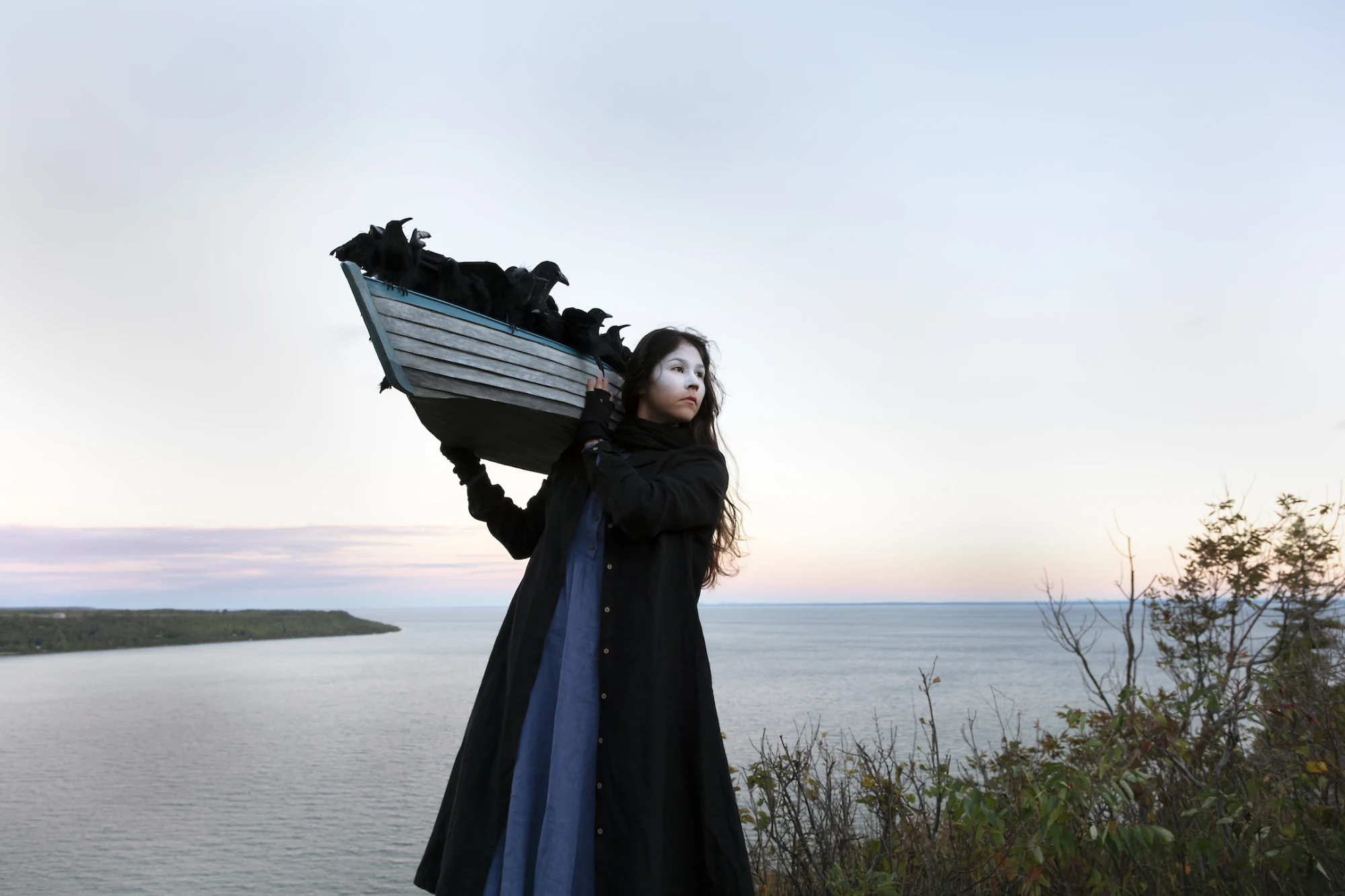
Meryl McMaster, On the Edge of this Immensity (detail), 2019. Chromogenic print mounted on aluminum composite panel, 101.6 x 152.4 x .3 cm. © Meryl McMaster Photo: NGC
Presence and performance are always bound in McMaster’s work. Her garments, masks, feathers, fabrics are not decoration, not props, they are performances that transform the body into something unstable, ceremonial, propagated. A photograph usually promises to fix identity, but her costuming makes identity provisional. Each costume is both excess and camouflage, revealing and concealing at once. Masks here are not tools of hiding but of expansiveness, to show the one self as many.
Her work is never still, even when her body holds stillness. In From a Still Unquiet Place (2019), she turns her back to us, face obscured by dark feathers, bells suspended from her hands. I could have read this as a portrait of silence. But my body won’t let me. In my ears, I hear the faint metallic ringing of bells that never sounded. The photograph itself doesn’t chime, yet it activates my hearing and folds sound into stillness. This is McMaster’s quiet genius: she draws the body into sensory registers photography cannot hold. Looking at her work, I imagine scents, temperatures, textures, sage, dusk air, the heaviness of plaid pressing against skin. Her photographs awaken ghost organs. They press into consciousness what cannot be pictured but can be sensed: weight, scent, sound, breath.
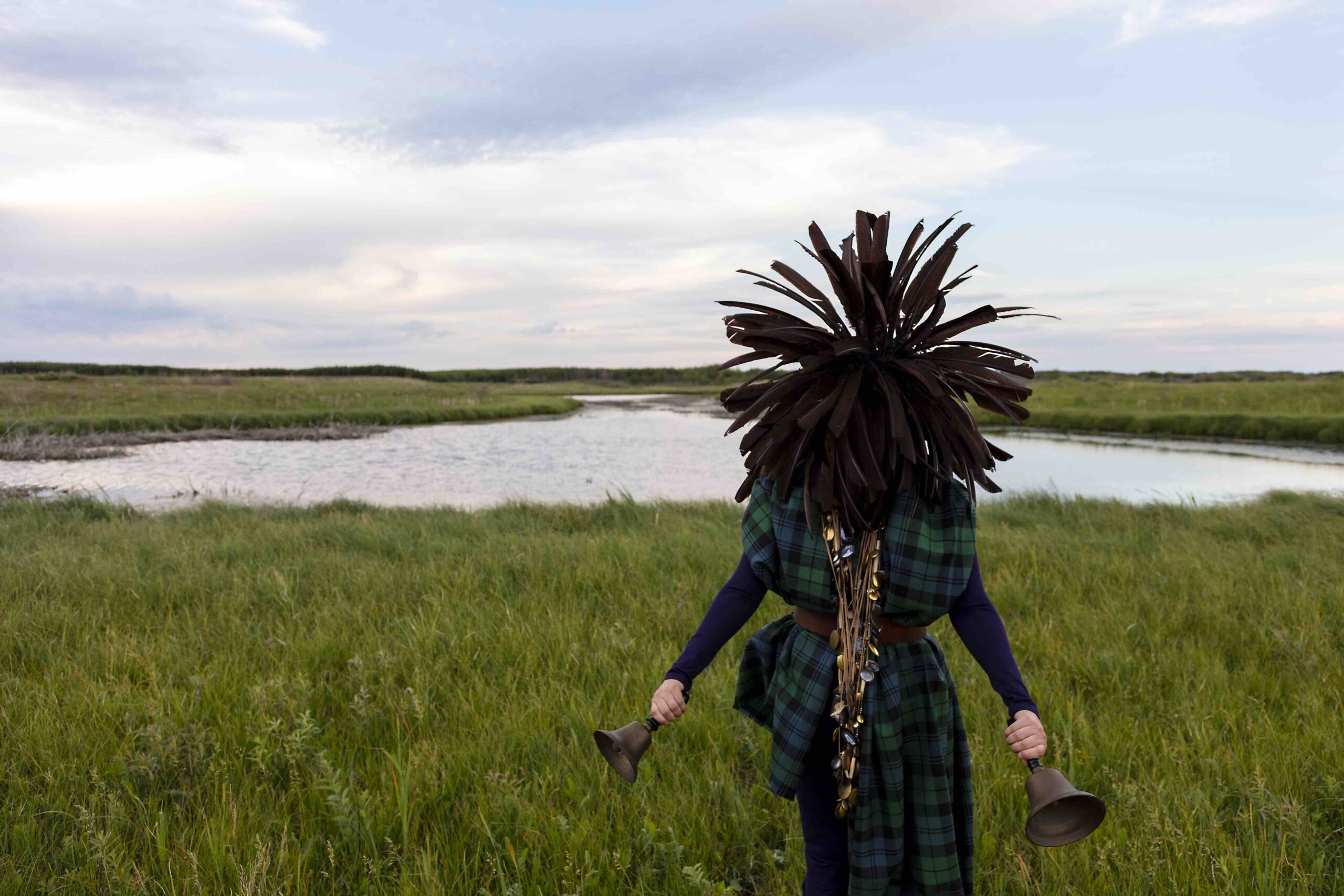
Meryl McMaster, From A Still Unquiet Place, 2019. Chromogenic print flush mounted on aluminum composite panel, 101.6 x 152.4 cm. Edition of 5 + 2 APs. © Meryl McMaster
So much of McMaster’s work is about turning away, obscuring, and refusing the directness that portraiture has always demanded. When she withholds her face, she is showing refusal itself as an image. A turned back becomes a declaration. Looking at that gesture, I am confronted with my own desire as a viewer, the urge to see, to decode, to own. Her refusal reveals my gaze’s hunger. It makes me aware of how much I have been trained to expect the photograph to give to me. McMaster’s images reveal the viewer’s insatiable appetite and hold a mirror to the colonial gaze itself, represented through the viewer with a subtle violence.
The gaze I bring to her work is not innocent. It is shaped by photography’s history of taking, of pinning down, of turning people into specimens. McMaster doesn’t let me forget that. Even when her images feel tender, sensory, ephemeral, there is also a wound running through them: the wound of looking itself. Standing before her photographs, I feel exposed by my own desire to see. This is a strange and powerful reversal her self-portraits end up showing me myself, my looking, my reaching.
In Lead Me to Places I Could Never Find on My Own I (2019), she glances back over her shoulder, crowned with two blue birds, sage basket pressing against her back. The land glows with dusk light, hills folding into shadow. I leaned in, my own body stretching toward something I cannot reach, wanting to see what she sees beyond the edge of the frame. The artist has staged not only her body, but mine and makes me aware of the desire to complete the picture, and of the impossibility of ever doing so.
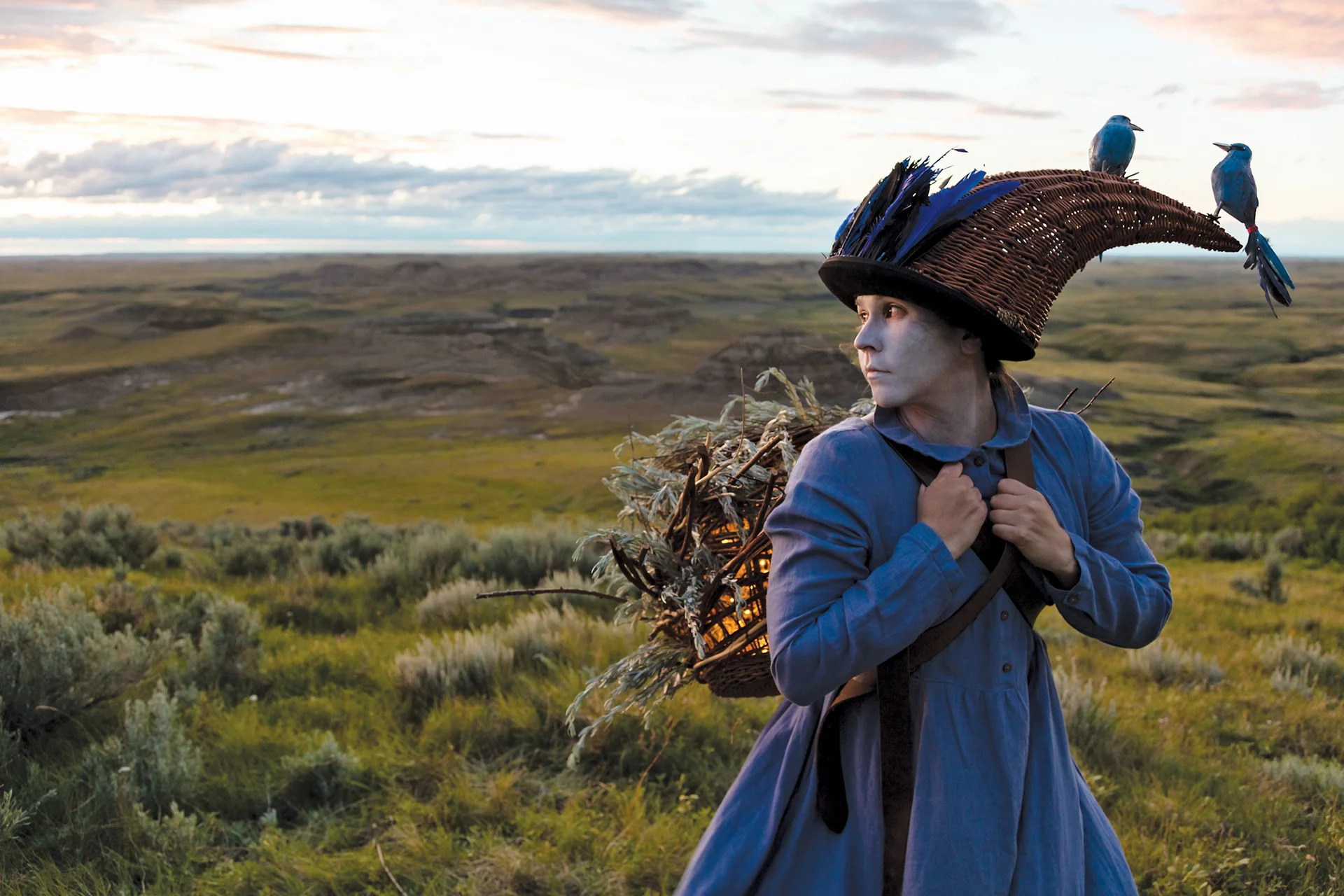
Meryl McMaster, Lead me to Places I Could Never Find On My Own I & II, 2019. Chromogenic print mounted on aluminum composite panel, 101.6 x 152.4 x 0.3 cm each. © Meryl McMaster Photo: NGC
The land here is not backdrop; it is collaborator, relative, witness. The sage, the birds, the cooling air withal reflect their own agency. McMaster never positions herself as interpreter of the land, but rather within in. Photography usually separates the figure from the background, but her work collapses that hierarchy. What emerges is not representation but relation. She is one among many presences, and her photographs stage that multiplicity. Each image is less a self-portrait than a gathering: of body, land, ancestors, animals, air.
What stays with me after encountering McMaster’s photographs is not explanation but afterimage. I carry away the sound of bells that never rang, the weight of cloth pressing on skin, the taste of dusk air cooling into night. These are residues more than meanings. They do not resolve into meaning; they linger as sensations, unsettled. McMaster does not give me closure. She leaves me in relation: to her, to the land, to my own gaze, to the archive’s broken hunger.
If the colonial archive once fed on Indigenous lives, flattening them into “Native Types,” McMaster answers by giving the camera more than it can swallow. Her photographs overload the frame feathers, fabric, birds, sage, and gestures balanced on the edge of collapse. What begins like a specimen dissolve into myth, memory, and imbalance. In this undoing, she refuses to be pinned down.
And that refusal is the point. In front of McMaster’s work, I notice how quickly my gaze wants to take more than it’s given to see behind the feathers, to decode the symbols, to complete the picture. She does not allow it. Instead, she confronts me with my own desire to consume, reminding me that even my looking is shaped by a history of capture. Yet her refusal is not bleak. It does not collapse into silence or absence. What her photographs leave behind is presence that cannot be taken presence that insists on relation rather than ownership, an encounter that stays alive precisely because it escapes possession.
Citations
[1] Alison May-Kosiewski, “Description as an Act of Othering: Towards Decolonizing Canadian Photo Archives,” The iJournal 10, no. 1 (Fall 2024): 120.
Reference
May-Kosiewski, Alison. “Description as an Act of Othering: Towards Decolonizing Canadian Photo Archives.” The iJournal 10, no. 1 (Fall 2024): 120–138.
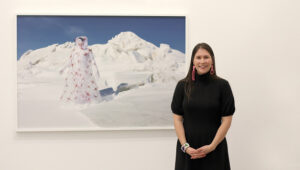 Meryl McMaster is nêhiyaw from Red Pheasant Cree Nation, a member of the Siksika Nation, and has Métis, Niitsitapi (Blackfoot), British and Dutch ancestry. Her work is predominantly photography based, incorporating the production of props, sculptural garments and performance, forming a synergy that transports the viewer out of the ordinary and into a space of contemplation and introspection. McMaster is the recipient of the King Charles Coronation Medal, Scotiabank New Generation Photography Award, the REVEAL Indigenous Art Award, Charles Pachter Prize for Emerging Artists, the Canon Canada Prize, the Eiteljorg Contemporary Art Fellowship, the OCAD U Medal and was long listed for the 2016 Sobey Art Award.
Her work has been acquired by various public collections within Canada and the United States, including the Canadian Museum of History, the Art Gallery of Ontario, Montreal Museum of Fine Arts, the Eiteljorg Museum, the National Museum of the American Indian, the Ottawa Art Gallery, the Nelson-Atkins Museum of Art and Indigenous and Northern Affairs Canada. Her work has been included in exhibitions throughout Canada, the United States and the United Kingdom, including the Smithsonian’s National Museum of American Indian, the Art Gallery of Ontario, Prefix Institute of Contemporary Art, the Eiteljorg Museum, the Ottawa Art Gallery, the Museum of Contemporary Native Arts, the McMichael Canadian Art Collection, the Mendel Art Gallery and the Art Gallery of Greater Victoria.
 I am Hooria Rajabzadeh, an Iranian lens-based artist. My practice focuses on the notions of identity and gender imbalance within the intersections of culture and race, often reflecting on my own and other Iranian lived experiences. Writing is an integral part of my artistic practice and informs both my image-making and critical engagement with art. I hold a Bachelor’s and a Master’s degree in photo-based art from the University of Tehran, as well as a Master’s degree in Fine Arts from the University of Regina.
I am actively engaged in the arts community in Regina and Saskatchewan, moving between artistic practice and cultural work. My work is shaped by experience within galleries and art institutions, where I have worked across curatorial assistance, instruction, writing, public and cultural programming, and community-driven projects.