Beyond the Mohawk T-Shirt
Beyond the Mohawk T-Shirt
Dana Claxton and the Juxtaposition of Identity
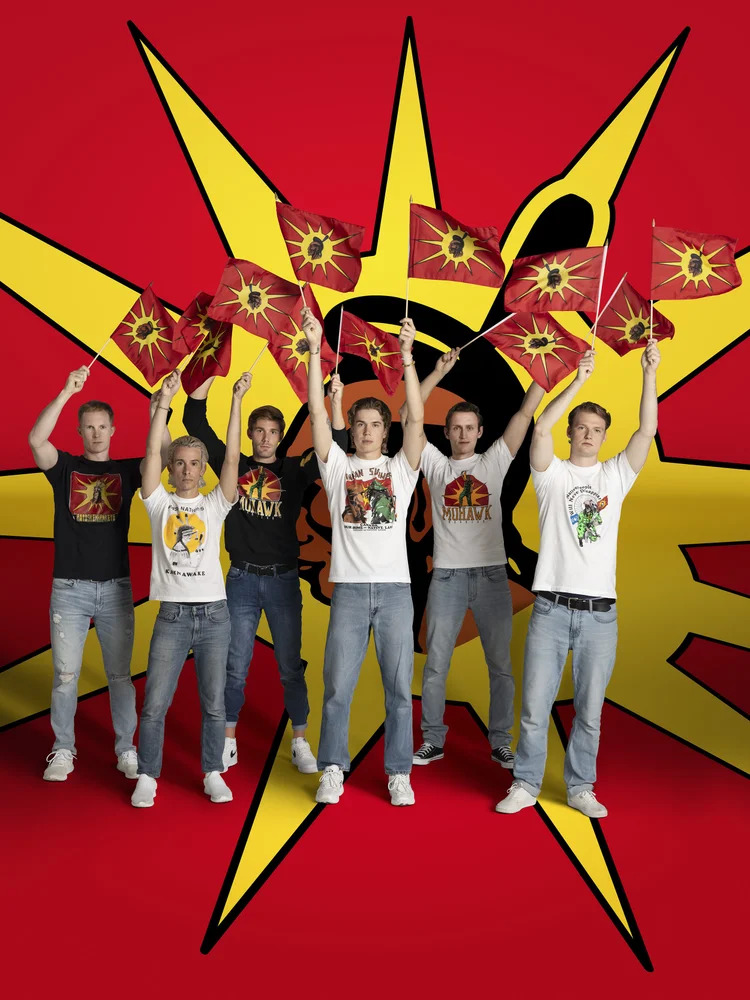
“Rick and the Mohawks (flags),” 2025. LED firebox with transmounted lightjet duratrans. 72 x 48 inches.
Interviewers: Zool Suleman, Rungh Magazine, and Justine “Tini” Stilborn, Indigenous Curatorial Collective (ICCA).
Artist: Dana Claxton
Zool Suleman (ZS): I want to start by thanking you for agreeing to this interview as a part of the partnership that Rungh Magazine and the Indigenous Curatorial Collective have. We are trying to engage with artists and build new conversations.
Your new work around some of the events that happened at [Peace Camp] at Oka [Kanien’kéhaka (Mohawk) lands]. When I first saw Rick and the Mohawks and the [exhibition] launch pictures, I was taken with the very strong vision and the kind of ideas you were trying to put forward. Tell me a bit about how the show came together, the T-shirts and some of the background.
Dana Claxton (DC): Thank you for having me. So how did it come together? Well, Rick Erickson, the fellow who gave me those T-shirts is a long-time friend of mine and he’s also one of the closest friends to Paul Wong.
During that time, they went to the Peace Camp outside of Montreal. […] And Paul was there as an artist curator. He curated Yellow Peril Reconsidered. It was showing in, I believe, Oboro. They went to the Peace Camp, of course, and all the artists went with him and Rick Erickson. At the Peace Camp there were primarily Mohawk people selling T-shirts on the sort of hoods of their cars. Rick bought a number of T-shirts from them. They [Paul and Rick] took a lot of […] pictures of everything that they saw while they were at Oka.
[Dana Claxton recounts she was living in New York at the time of the events of Oka and how Oka was] One thing that actually that sparked me to want to move back to Canada, thinking I could come back to Canada and do something that was going to save our country right.
Dana Claxton: I did come back to Canada and then started actually working at an artist run center – the Pitt Gallery. Initially just started by being an artist and doing projects with the lovely group who were there. […] The sacred run was going to happen. So, it was a year later in the anniversary. In Indigenous cultures, there was the runner, and you would run from community to community to check in to make sure people were fine, that they were safe. There was a run that was going from Vancouver to Oka.
[Dana Claxton explains how a runner on the sacred run asked the Pitt Gallery to sponsor their run from Vancouver to Oka and how Rick Erickson was sponsoring this runner from Vancouver. Rick and Paul flew to Oka for the anniversary]
Dana Claxton: At this [anniversary] event [at Oka] this time it was indoors. It wasn’t outdoors where the [original] Peace camp was and there were several vendors with table setup selling T-shirts, and so some of them were quite different, you can imagine, from the Peace camp, because also, you know, this situation had happened, in the standoff. So, there was different messaging [and] different aesthetics in the second batch of T-shirts.
[Rick and Paul wore these shirts] and I think it was 35 years later. And he [Rick, had] accumulated a lot of things over the years and [Rick] saves things. He’s not one to throw things out, but also archives things because he’s also an art collector. [Rick] invited me over [and] there was [this] larger group of the Mohawk T-shirts, and so [we] went through them all. And of course. [I was] elated […] because they’re all so beautiful. They’re all different. They all have different, you know, quote slogans and statements and beautiful imagery. They were gifted to me […] from his collection.
[Years later, Dana Claxton, recounts that she was airing out the shirts] That’s when you know you hear these ideas of what comes to artists sometimes right? And sometimes you do a great amount of research, and then things come to you and other times […] a beautiful image came, and I had decided to audition […] seemingly non-Indigenous, blonde Caucasian men to wear these T-shirts, and then to photograph them.
Zool Suleman: What was that juxtaposition like? What? What were you sort of exploring with [the Mohawk resistance flag] and these models? That juxtaposition?
Dana Claxton: It’s really a totality of all of that. First, it was to honor Rick because he’s been a very generous man for many, many years. He’s a lovely art patron here in the city. And so it was to honor, pay, homage to him, but also, of course, to honor and pay homage to the Mohawk resistance. […] It’s still a complex situation in Canadian history, and still has rippling effects […] and then also to think about the complexity of casting seemingly non-Indigenous men in these T-shirts that are highly charged for some people. And also, further unpacking it. […] As we discussed in the pre-interview, is thinking about essentialism and […] these ideas that, only a Mohawk can wear a Mohawk t-shirt, or only an Indigenous person can wear a Mohawk T-shirt.
those things are really profound questions that haunt this landscape, and probably will for a long time. I was interested in that. […] Seeing these men in these T-shirts, these highly charged political T-shirts. […] Indigenous people come in all different hues, right? And people, I know, blonde-haired, blue-eyed Indians, and also blonde hair, blue eyed Mohawks.
Zool Suleman: How many final pieces were actually in the exhibition? Can you just tell us a bit about that.
Dana Claxton: There were just four final works for the exhibition but I probably took 1,500 images.

“Rick and the Mohawks (reclined column),” 2025. Inkjet print. 19 x 95 inches.
Zool Suleman: Have you had any kind of response around this conception of indigenous essentialism. You know we live in a very complex time in terms of the overlays around those kinds of questions. I come to it from conversations in the late eighties, early nineties around identity, politics and essentialism. In the communities from which I come there’s a very road range of views.
Dana Claxton: …it was interesting at the opening, and people saying, I’m conflicted. I don’t know how to look at these images. How do you want me to read these images? […] A lovely young Mohawk artist came and looked and said, ‘how do you want me to read these images, Dana?’
[Dana Claxton references an artist talk she gave about the exhibition] […] We’re talking about essentialism, and who gets to wear what? And then a question at the Q and A that became, part of the discussion, ‘who has the right to wear what’?
What’s the right language? I don’t want to be dismissive of everybody […] but I found it intriguing that people would think that they don’t, that they shouldn’t wear something. Yeah, I mean, but don’t get me wrong, if anybody’s gonna wear [a] war bonnet I’ll be the first person to say, ‘What are you doing? Take that off right’. […] but just things that are made for the market. ( like tshirts are for everyone)
it’s complicated, because, like now, with repatriation and those kind of things, and thinking of cannupas and pipes, […] Some were made for the market or ledger drawings, because that’s become quite controversial of anybody earning [from] ledger drawings. Some were made for the market, but they were made by men who were in jail at the time. It’s all very complicated or thinking of out here on the coast.
So, are those T-shirts in some ways, for some people.
Zool Suleman: When I look at the images [of the t-shirts and models], they are […] engaging and they are commercial. […] I just wanted to kind of explore a bit of that. The idea of consumption and capital and art making and then these prohibitions. Is it about permission? Does the artist, do you, the artist, give permission when you make this work for it to be consumed? Or does that even come into your [art making] process?
Dana Claxton: I always say that, capital is a byproduct of making art.
Dana Claxton: I’m making art to make art. I’m grateful for collectors and museum acquisitions. if you start making art with that intention –( of only selling art) , I just think it’s going to go downhill from there you know, for me, anyhow. So, I just make art that I need to make. It’s intuitive. I want to see these images. I want to explore something, and then the work comes out, and it is what it is, but ( the ) market’s a byproduct. […] Certainly, capital has always been married to art. They go hand in hand in some ways, and then. That’s a whole complex relationship – the corporate world, and art, and indigenous treaties, I mean, those are complex relations.
[…]
Justine “Tini” Stilborn: I had a question specifically about identity politics from the nineties. All the models wearing the shirts are non-indigenous presenting, but they’re also very young. They’re also likely of an age group that [were children], or even not born at the time when the Oka crisis happened. When creating this exhibition was there an intention to educate younger generations about what had occurred there?
Dana Claxton: Thank you for that question, and I wish I had that kind of insight when I was [making the art], but no. Rick was young when he went to Oka and so that’s why they’re young. They’re all sort of around his age, or a bit younger, but they’re all around his age.
I haven’t worked with a lot of non-Indigenous actors or models before. During the casting session, I did ask them questions about their relationship to Indigenous people and Indigenous histories. The answers were all so beautiful and thoughtful, some naïve. […] When the gallery sent out a press release. Then there’s information on the website. I said, ‘I think we need to contextualize this and have a learning space. Let’s learn together.’ ( realizing the Mohawl resistance/ OKA wasn’t common knowledge that we needed provide information)
To call my show Rick and the Mohawks, I was so conflicted. […] I consulted different Indigenous political thinkers and then consulted Mohawk artists. Those were fascinating conversations. They [gave] me goosebumps. They were fascinating conversations of who has the right to use the word Mohawk in the title of their work. I took it to mean [there is ] a responsibility to have this word in the title of my art.
Acknowledgement: This article (“Beyond the Mohawk T-Shirt: Dana Claxton and the Juxtaposition of Identity”) was originally written as part of the partnership between ICCA and Rungh Magazine. As part of our long-term collaboration, ICCA offers writing opportunities for our community members while highlighting BIPOC exhibitions and programming in Rungh.
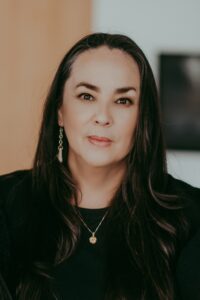 Dana Claxton is a critically acclaimed artist who works with film, video, photography, single/multi- channel video installation, and performance art. Her practice investigates indigenous beauty, the body, the socio-political and the spiritual. Her work has been shown at the Museum of Modern Art (NYC), Metropolitan Museum of Art (NYC), Walker Art Centre (Minneapolis, MN), Sundance Film Festival, Salt Lake City (UT), Eiteljorg Museum of American Indians and Western Art, Indianapolis (IN), Museum of Contemporary Art (Sydney, AU), Crystal Bridges Museum of American Art (Bentonville, AR), Nasher Museum of Art at Duke University (Durham, NC), Memphis Brooks Museum of Art (TN) and the Minneapolis Institute of Art (MN). Her work is held in public, private and corporate collections including the National Gallery of Canada, Winnipeg Art Gallery, Vancouver Art Gallery, Mackenzie Art Gallery, Audain Museum, Museum of Modern Art, Getty Museum, Eiteljorg Museum, Seattle Art Museum, Forge Project, Minneapolis Institute of Art, University of Toronto, Nerman Museum of Contemporary Art and the Moose Jaw Museum and Art Gallery.
She has received the VIVA Award (2001), the Eiteljorg Fellowship (2007), the Hnatyshyn Foundation Visual Arts Award (2019), the YWCA Women of Distinction Award (2019), the Governor General’s Award in Visual and Media Arts (2020), the Scotiabank Photography Award (2020), and the Audain Prize for the Visual Arts (2023). She is the winner of Best Experimental film at the IMAGINATIVE Film and Media Arts Festival (2013).
Fringing the Cube, her solo survey exhibition, was mounted at the Vancouver Art Gallery (2018) and the body of work Headdress premiered at the inaugural Toronto Biennial of Art, Toronto ON (2019). Her latest solo exhibition Dana Claxton: Spark opened at the Baltimore Museum of Art in August 2024.
She is a Professor in the Department of Art History, Visual Art and Theory with the University of British Columbia. She is a member of Wood Mountain Lakota First Nations located in SW Saskatchewan and she resides in Vancouver Canada.
Dana comments, “I am grateful for all the support my artwork and cultural work has received. I am indebted to the sun and my sundance teachings – mni ki wakan – water is sacred. ”
Share This Article

Written by : Publications
Follow Us on Social Media
Join our Membership

October 19, 2026
October 19, 2026
October 19, 2026