
As if it were our life itself:
Tania Willard’s Declaration of the Understory
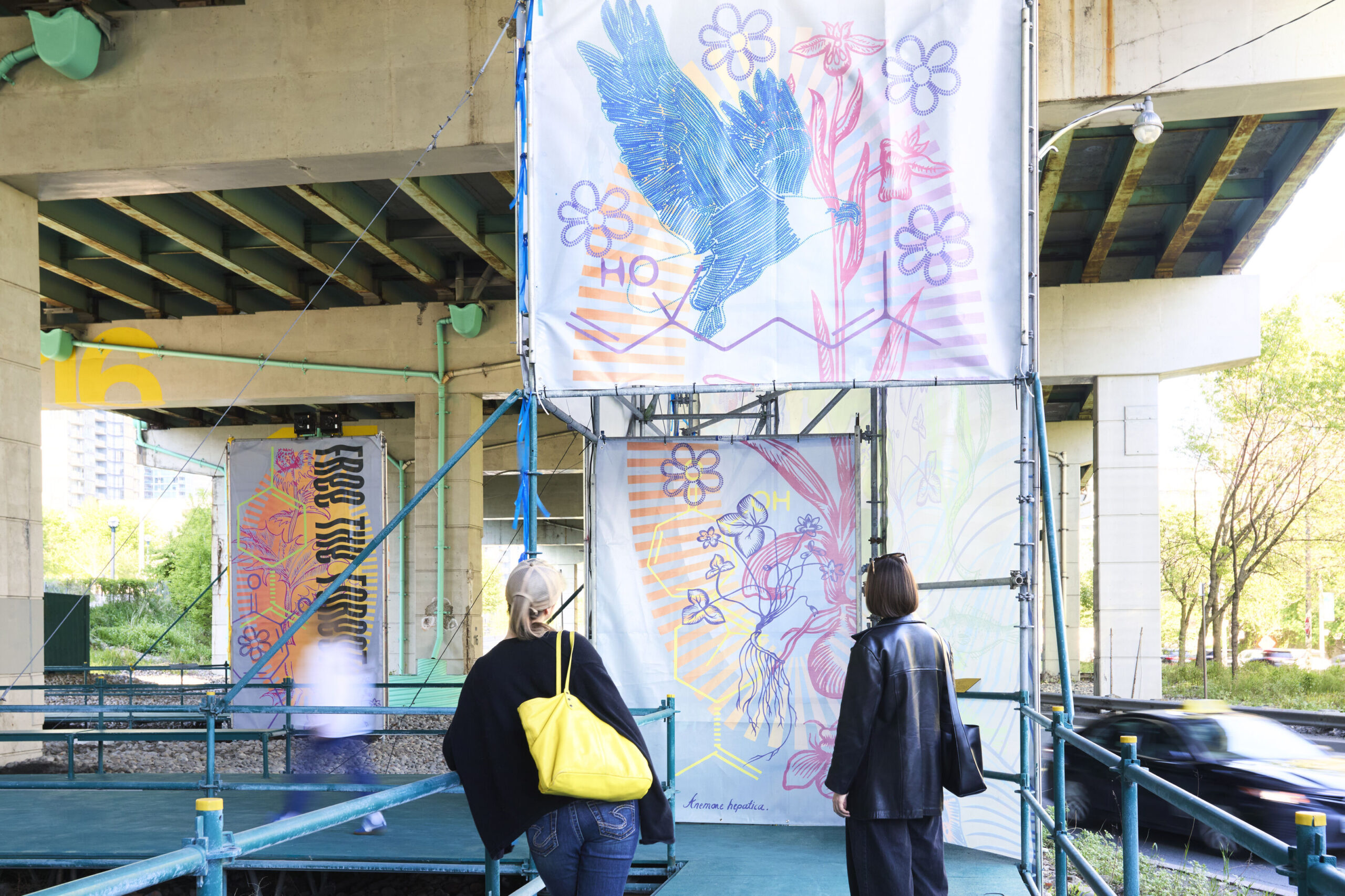
Declaration of the Understory – Tania Willard at The Bentway, 2025, Photo Credit: The Bentway
By Dana Prieto
“Night does not bring a vanishing of light, night turns to day; light is never vanishing, it is always giving us focus.”
-Tania Willard in “Witnessing the Persistence of Light,” 2016
Since I was a little kid, passing under a bridge or highway has felt like traversing a portal. If you’re carrying luck, a train passes overhead and you get to make a wish. Close your eyes briefly, hear the cars crossing. You gotta be quick to catch it at the exact moment.
There.
For months, I drove past the intersection of Dan Leckie Way and Lake Shore Boulevard bordering Toronto’s waterfront, with the kind of concentrated distraction that should probably revoke my license. One eye on the road, the other scanning the underbelly of the Gardiner Expressway, trying to spot anything new inside the teal structures of Staging Grounds. I was looking for growth, checking on the site like it was a distant friend.
Usually, I saw nothing. Or more so, I saw the same things: the tall, blocky concrete legs, ribs and arteries of the Gardiner, threaded with bright green pipes, platforms, and other infrastructural forms that speak the language of the highway so fluently they nearly disappear into it. Which is part of the point.
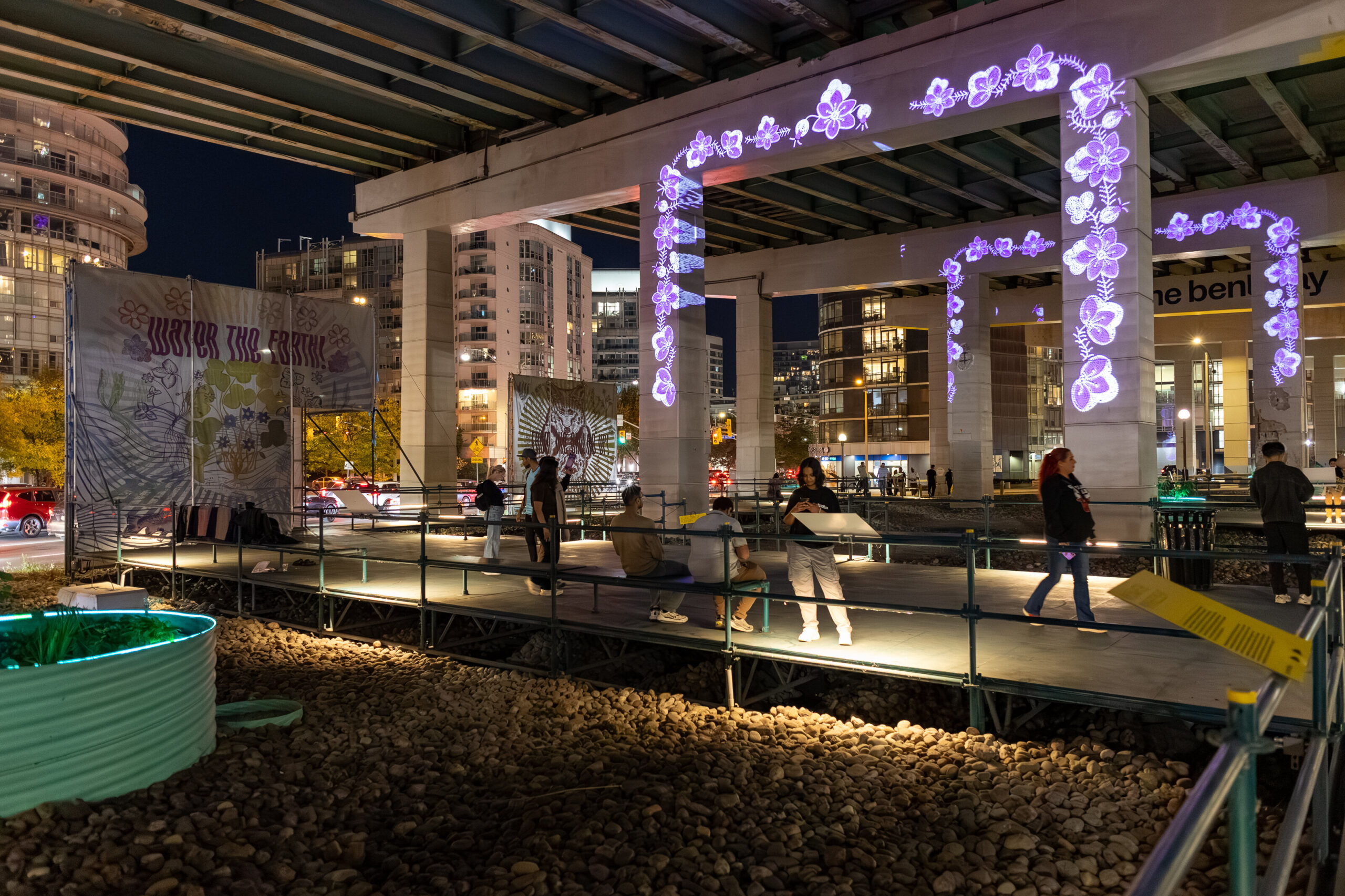
Declaration of the Understory – Tania Willard at The Bentway, Nuit Blanche 2025, Photo Credit: Mila Bright Zlatanovic
Commissioned by The Bentway and designed by SHEEEP (Toronto) and Agency—Agency (New York City), with engineering, graphic design, and Indigenous horticultural expertise threaded throughout, Staging Grounds partly functions like most urban ecological infrastructure; it is almost imperceptible when it’s working. This “living laboratory” and public art experiment collects runoff water from the Gardiner above to irrigate a system of oversized planters below, filled with a variety of native plant species. [1] Alongside an arrangement of interconnected platforms and containers on the ground, the staging piece of the project is purposely left vacant for others to activate, be them planned artistic interventions or impromptu human and non-human visitations. Passing and glancing on my commutes, I had not yet identified any traces of the artistic programs flourishing on site.
But then one night, from the split-second gap between a text notification and a stoplight, still in motion, still half-seeing, I stuttered when I caught a luminous arch of purple flowers wrapping the concrete like a spell.
Tania Willard’s Declaration of the Understory (2025–26) turns this stretch under the Gardiner into something that insists on a different kind of attention. Light- and time-based, the work engages with the site’s shifts from day to night, from summer brightness to the winter dim, drawing on strategies from the forest understory: like deep red foliage and reflective, iridescent elements that come alive when the light goes down. [2] Tania’s work doesn’t decorate or remediate the Gardiner’s infrastructures and ecologies so much as complicate them. Shimmering our gaze off the concrete, Declaration pulls us toward what’s underneath, what persists, and what is being actively managed out of sight.
Tania is a Secwépemc and settler-Scottish artist, curator, and educator; an activator of BUSH Gallery, director of the UBC Okanagan Gallery; and director/curator of the Morris and Helen Belkin Art Gallery in Vancouver. She received the Sobey Art Award in 2025, and she continues to grow prodigious amounts of garlic at her home on Neskonlith lands. Tania is a person that moves between institutions, land-based work, and community with grace, clarity, and genuine commitment.
I work with Tania through the podcast Sounds Like Land, which she co-hosts with Lisa Myers, and I coordinate the project. That means I spend a lot of time in the background with the emails, agendas, schedules, and budgets; in the soft chaos of collaboration. More than once, Tania has joined a meeting call from the bush, mid-planting or harvest season. Her undivided dedication to her land, and to Secwépemc plant knowledge and language revitalization shapes the work we make in the podcast, and keeps sprouting throughout her artistic practice.
Tania’s Declaration stretches east-west along the Gardiner, with a series of large-scale reflective banners, and a light-based pattern that frames the concrete arches. At the center of these motifs is the hepatica: rounded purple blooms that glow through the brutalism overhead. The flowers are projected onto the site with the kind of crisp definition one might recognize from elsewhere in the city: the rotating gobo lights marking the sidewalk outside a restaurant, the ordinary urban signage that tells you where to go and what to buy.
Some of the most direct interruptions to Toronto’s expansive settler colonial and consumption-driven signals have been linguistic. Ogimaa Mikana, a collective formed by Susan Blight and Hayden King, has replaced English street names and colonial plaque text with Anishinaabemowin place-names, using the ordinary surfaces of navigation (street signs, plaques, billboards) as sites for reclaiming space while asserting Indigenous presence and worldviews. There’s a kinship here with Tania’s projections: both interrupt the city, refusing to allow the settler-state to define the visible narratives of Toronto’s public language.
The title of Tania’s work is borrowed from the “Declaration on Understory within the Forests of Secwepemculecw,” a Secwépemc document that asserts Indigenous governance, rights and responsibilities to the understory: those smaller, often overlooked beings and relations beneath the forest canopy. In a personal conversation, Tania explained to me that the understory is where medicines and berries grow, where regeneration emerges after a fire, where the ground remembers. [3] The document anchors the value of the understory not in transactional terms, but as sustenance, relationships, law, and responsibility.
Hepatica is an understory plant native to Southern Ontario. It is a small, slow-growing, and early-blooming perennial, often one of the first to insist on life after winter. In Anishinaabemowin, the Greenbelt Indigenous Botanical Survey records hepatica as a’nima’sid or animozid in the Ojibwe People’s Dictionary, which translates to dog’s paw, and references the round-lobed shape of the plant’s leaves. Closely related to anemones and the buttercup family, hepaticas have been used for centuries as a medicine, despite its irritating and toxic properties when fresh. These small purple flowers are found throughout Ontario’s Carolinian forest, one of the most biodiverse regions in the country, that has been reduced to fragmented pockets in Canada’s most urbanized corridors, losing more than 90 per cent of its original extent since colonization. [4] And much like other understory plant species, hepatica moves with light: the flowers close at night and in rain, folding back into themselves until conditions become brighter again.
Tania’s practice has been thinking with light for a long time. Beyond mere illumination, she engages with light as a material, an agent, a process, and a medium that has been shaping our planet before it was even formed as such. For Photolithics (2026), an upcoming solo exhibition at Polygon Gallery, she grounds her work with her 2016 essay called “Witnessing the Persistence of Light,” where she writes: “Light has been making life, images, shadows, and reflections for billions of years.” [5] In this critical analysis of lens-based colonial traditions, Tania traces the ecological, historical, and geological relations between light, photography, and stones, asserting them as documents that hold the deep relationships between Indigenous peoples and their lands. [6]
In Declaration of the Understory Tania reinterprets the site below Toronto’s waterfront highway as a different type of understory: a place where social, cultural, and ecological relations continue to grow beneath the loud surfaces of circulation and exchange, amid the city’s and province’s steady devotion to profit-oriented development. [7] The recent closure of Ontario’s Science Centre, the planned remaking of Ontario Place, and the passing of Ontario’s Bill 5 disproportionately threaten Indigenous rights and the protection of native species, in service of accelerating the construction of highways, mines, and housing. [8] At this arterial intersection, Dan Leckie’s name lingers as a small trace of another political imagination, one shaped by food justice, environmental stewardship, and dignifying public life. [9]
Under the Gardiner, where commuters, cyclists, half-watchers, and rain waters are passing and re-routed into distinct parts of the city’s infrastructure, Tania’s Declaration works like a portal that may slow us down, or slightly re-orient us. It won’t transport us somewhere else. But it can make us return, even briefly, to what was already there.
[1] https://thebentway.ca/event/bentway-staging-grounds/
[2] The Bentway. “Declaration of the Understory.” Accessed February 20, 2026. https://thebentway.ca/event/declaration-of-the-understory/
[3] Personal conversation with Tania Willard on February 10, 2026
[4] Michela Rosano, “The unravelling quilt: Fighting for what remains of Canada’s Carolinian forest,” Canadian Geographic, Nov 21 2025 https://canadiangeographic.ca/articles/the-unravelling-quilt-fighting-for-what-remains-of-canadas-carolinian-forest/#:~:text=But%20the%20quilt%20is%20unravelling,in%20the%20Lake%20Erie%20breeze.
[5] The essay was written by Tania Willard for “Nanitch: Early Photographs Of British Columbia From The Langmann Collection,” a show she co-curated with Heather Caverhill and Helga Pakasaar at The Polygon Gallery (then called Presentation House).
[6] The Polygon Gallery. “The Polygon Gallery Presents Tania Willard’s Photolithics.” February 2, 2026. https://thepolygon.ca/news/the-polygon-gallery-presents-tania-willards-photolithics/
[7] Anushka Yadav, “Ontario’s Growing Environmental Crisis: How Two Major Projects Are Harming the Great Lakes.” The Pointer, January 28, 2025. https://thepointer.com/article/2025-01-28/ontario-s-growing-environmental-crisis-how-two-major-projects-are-harming-the-great-lakes
[8] Chiefs of Ontario. “Protecting Our Lands: A First Nations Response to Bill 5 & Bill C-5.” Last modified September 18, 2025. https://chiefs-of-ontario.org/resources/protecting-our-lands/
[9] City of Toronto. Draft By-law – Renaming portions of Lower Portland Street, between Front Street West and Queens Quay West as Dan Leckie Way (Trinity-Spadina, Ward 20). Report No. 10, Clause No. 5. Toronto City Council, October 1–3, 2002. PDF. https://www.toronto.ca/legdocs/2002/agendas/council/cc021001/to10rpt/cl005.pdf
Acknowledgement: This article (“Declaration of the Understory”) was originally written as part of the partnership between ICCA and Rungh Magazine. As part of our long-term collaboration, ICCA offers writing opportunities for our community members while highlighting BIPOC exhibitions and programming in Rungh.
 Tania Willard is a mixed Secwépemc and settler artist whose research intersects with land-based art practices. Her practice activates connection to land, culture, and family, centering art as an Indigenous resurgent act, though collaborative projects such as BUSH Gallery and support of language revitalization in Secwépemc communities. Her artistic and curatorial work includes Beat Nation: Art, Hip Hop and Aboriginal Culture at the Vancouver Art Gallery (2012-2014) and Exposure: Native Art and Political Ecology at the IAIA Museum of Contemporary Native Arts, Santa Fe (ongoing). Willard’s work is included in the collections of the Vancouver Art Gallery, Forge Project NY, Kamloops Art Gallery, Belkin gallery and the Anchorage Museum, among others. In 2016, she received the Hnatyshyn Foundation’s Award for Curatorial Excellence in Contemporary Art. In 2020, the Shadbolt Foundation awarded her their VIVA Award for outstanding achievement and commitment in her art practice, and in 2022 she was named a Forge Project Fellow for her land-based, community-engaged artistic practice. In 2023 BUSH Gallery was named as a Future Studies recipient from Ruth Foundation for the Arts. In 2025 Willard won one of the top Canadian contemporary art awards, the Sobey Art Award. Willard is an Associate Professor in The Department of Art History, Visual Art and Theory (AHVA) at the University of British Columbia
 Dana Prieto is a site-responsive artist, educator, and researcher based in Tkaronto. Her practice examines personal and collective relations with colonial infrastructures through a careful attention to the ground, and the different forms of living and dying within it. She holds a Master of Visual Studies from University of Toronto, and her work has been presented in national and international galleries, public spaces, and informal cultural venues. Dana is a co-founder and facilitator at SHEEEPschool, a research associate for Finding Flowers project, and the coordinator of the podcast “Sounds Like Land.” www.danaprieto.com