Echoes of the Road Allowance
Reflecting on Arnolda Dufor Bowes’ Apples and Train Tracks
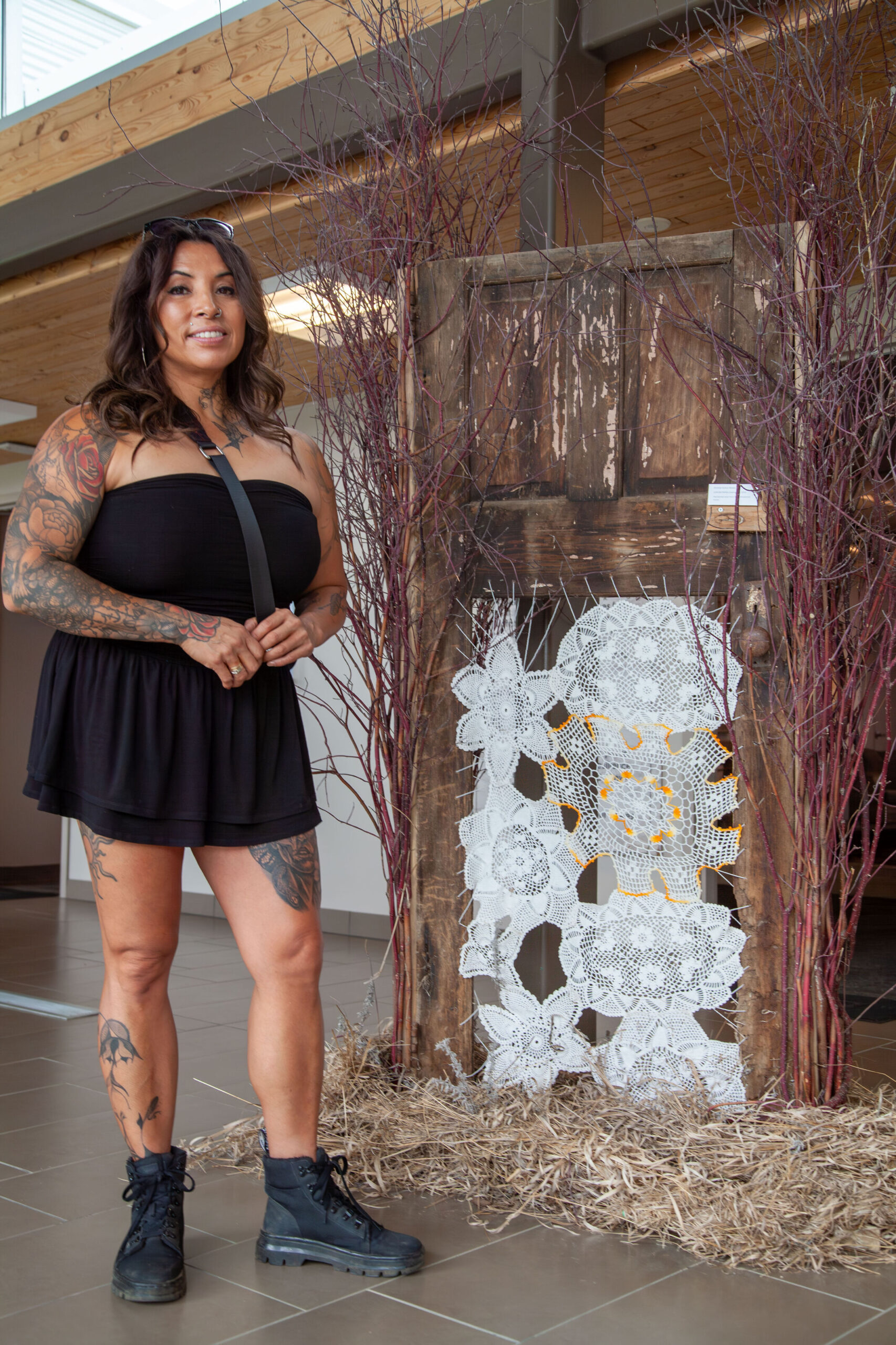
A door taken from Arnolda Dufour Bowes’s father’s childhood home, an old building where he used to live in the Punnichy area, which still stands today.
By Bee Bird
When visiting Back to Batoche Days, July 19, 2025, I stopped at the Batoche National Historic Site Museum. A field of flags gently moving in the wind first caught my eye; one a Canadian flag, another carried the infinity symbol of the Métis Nation. The monument to Louis Riel, a reminder of resistance, vision, and the cost of leadership stood close by. For a moment, I stood still. There is something about this place that asks you to listen. The land speaks. So do the people who return here year after year.
Inside the museum, I saw Arnolda Dufour Bowes standing beside a weathered wooden door, framed by tall red willows that reached upward like memory itself. At first glance, it looked like nothing more than wood and lace. But standing before it, the air felt different, as if the space itself held breath. “That door is from my father’s old house in Punnichy. It is still standing, and when I was given permission to take it, I knew it had to become part of this story,” Arnolda says.
The door is the threshold into her exhibition “Apples and Train Tracks.” Inside, the scent of wood and earth mixes with the quiet weight of memory. The work is built from reclaimed pieces of her father’s Road Allowance home, with red willow branches, poetry, and painted canvases. It is a place where personal memory meets collective history. Every board, photograph, brushstroke are part of a living archive of the Road Allowance Métis.
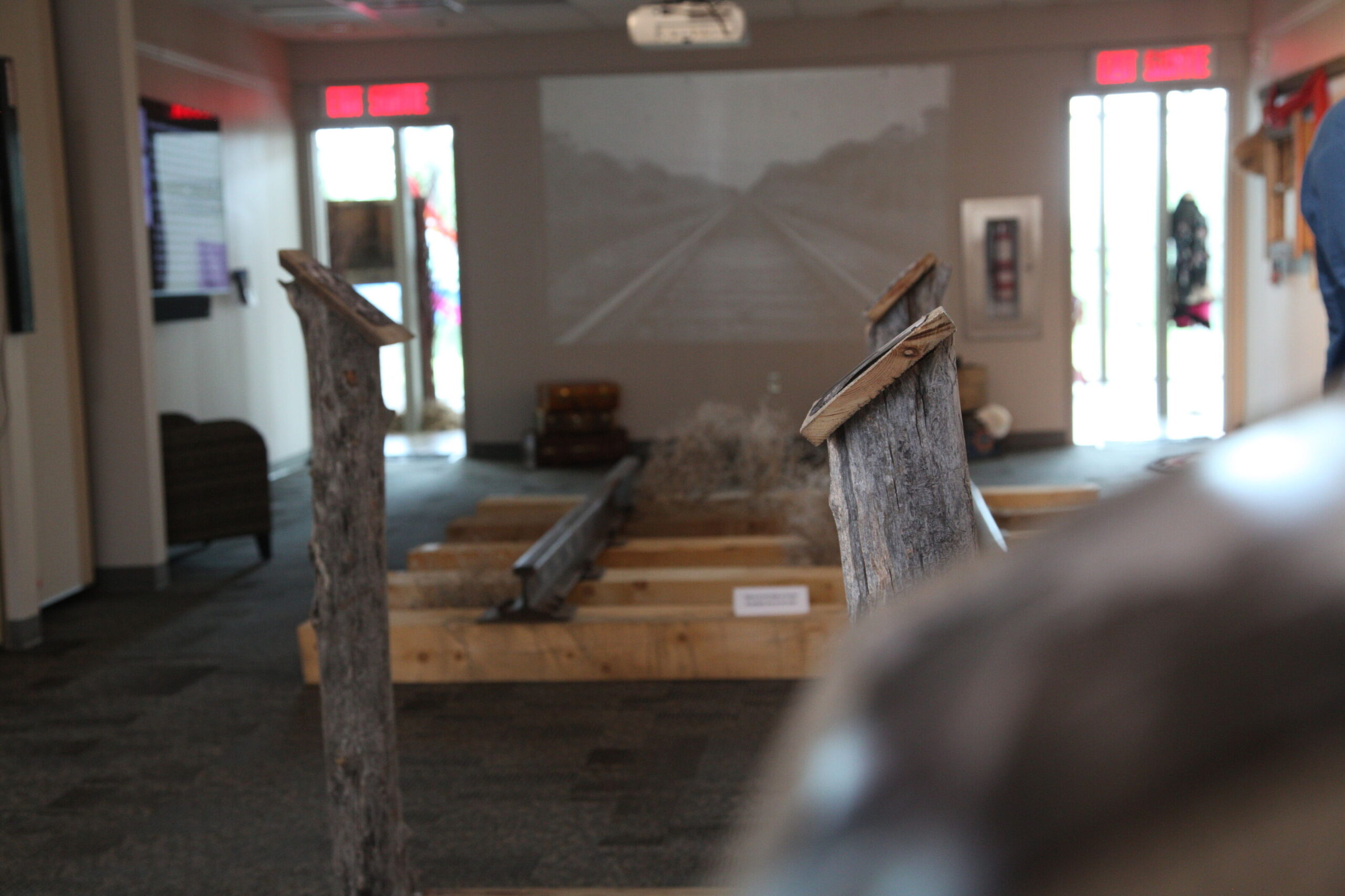
An interior shot from Arnolda Dufour Bowes’s exhibition Apples and Train Tracks, named after the play from her firstbook, 20.12m: A Short Story Collection of a Life Lived as a Road Allowance Metis.
One side of the gallery holds a narrow wooden walkway. Along the fence posts are photos of Road Allowance families from Erin Ferry, Saskatchewan, each one fixed in place, a marker of belonging. At the far end sits a section of train track. On it, a short film plays, images and sound brought together pulling you into a time when displacement was an everyday reality. The recording tells of the Métis families who lived on Crown land, who were pushed to the edges of towns and farms, and later moved under government programs.
“This is our history,” Arnolda says. “Told from us, not about us.” In her voice, there is both the gravity of truth and the steadiness of someone who knows that telling it is an act of survival.
Arnolda’s sister, Andrea Haughian, created some of the paintings in the exhibit. Her style, abstract realism, carries the texture of lived experience. The collaboration between the sisters is a form of cultural expression, showing how identity is shaped and carried by family as much as through history.
Her work is not only about the past; it is also about how identity moves forward. In one painting, a father and his young child stand hand in hand at the edge of a long red train. The boy looks upward, his small figure tethered to both the man beside him and the steel that stretches across the canvas. Above them, the prairie sky opens wide, a reminder of both freedom and uncertainty. The painting holds a quiet truth: identity is carried in these intergenerational moments, in the act of holding on even when the world is shifting around you.
Walking through the exhibit, I thought about how identity is not a single moment but a layering of stories, memories, and relationships. Arnolda’s installation makes that truth physical. As I moved through, I saw the faces, and felt the grain of the wood under my hand. “It is not about getting sympathy, but empathy,” Arnolda told me.
As I left the gallery, I turned back to look at the door one more time. It stood open, framed by the red willows, an invitation and a reminder. Identity, like that doorway, is something you step through again and again. Each time, you carry a little more of the story with you.
For me, visiting Arnolda’s exhibition was not just about seeing art. It was about feeling the weight and beauty of a people’s story told in their own voice. It was about understanding that identity is not something fixed on a page or hung on a wall. It is something lived, reclaimed, and shared.
Acknowledgement: This article (Echoes of the Road Allowance) was originally written as part of the partnership between ICCA and Rungh Magazine. As part of our long-term collaboration, ICCA offers writing opportunities for our community members while highlighting BIPOC exhibitions and programming in Rungh.
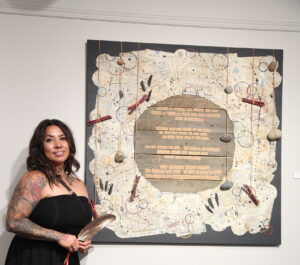 Arnolda Dufour Bowes is a Cree-Métis storyteller, author, and artist with family ties to Sakitawak (Île-à-la-Crosse), the Lestock/Punnichy Métis Road Allowance, and George Gordon First Nation Reserve. She is also a devoted mother and auntie.
Her multi-sensory art exhibit, Apples and Train Tracks, shares the lives and trials of the Road Allowance Métis in Saskatchewan. Through this work, Bowes explores the displacement events that occurred during the 1940s and highlights how her people persevered despite government attempts to erase their homes, traditions, and ways of life. While the exhibit addresses these traumatic events, it also celebrates the irrepressible spirit, light-heartedness, and hope inherent in Métis culture, emphasizing resilience and survival.
Bowes’ goal as a storyteller is to bring these truths to light and into the homes of those who may not have grown up with this history or be familiar with the Métis experience. Her intention is for audiences to engage with the stories empathetically, not sympathetically, and to recognize the goodness, creativity, and strength within Métis culture. Through Apples and Train Tracks, visitors are invited to walk in the moccasins of the Métis, hear their stories, and witness the experiences that have shaped the community’s tenacity.
Her work reflects a commitment to using art and storytelling to foster understanding and connection. Bowes believes that history is not only about challenges endured but also about the remarkable resilience, tradition, and connectedness of Indigenous peoples. Her artistic practice emphasizes celebrating these strengths while acknowledging the complexity of Métis and Indigenous experiences in Canada.
 Bee Bird is a multidisciplinary artist and filmmaker from Montreal Lake Cree Nation, based in Regina on Treaty 4 Territory with roots in Treaty 6. Grounded in his Woodland Cree heritage, his work is dedicated to amplifying Indigenous voices through film, storytelling, and cultural expression. Bee creates community-driven projects that spotlight Indigenous artists, explore urban Indigeneity, and celebrate lived experiences. Driven by community connection, cultural pride, and self-determination, he is passionate about fostering safe, empowering spaces where Indigenous stories can thrive. He moves between documentary, narrative, and poetry, mixing traditional and modern styles to show the beauty and strength of Indigenous life, while helping others tell their stories too.