Transforming Intention into Visual Language
Reflecting on Lilian Bonin’s Cartographie de Mémoire
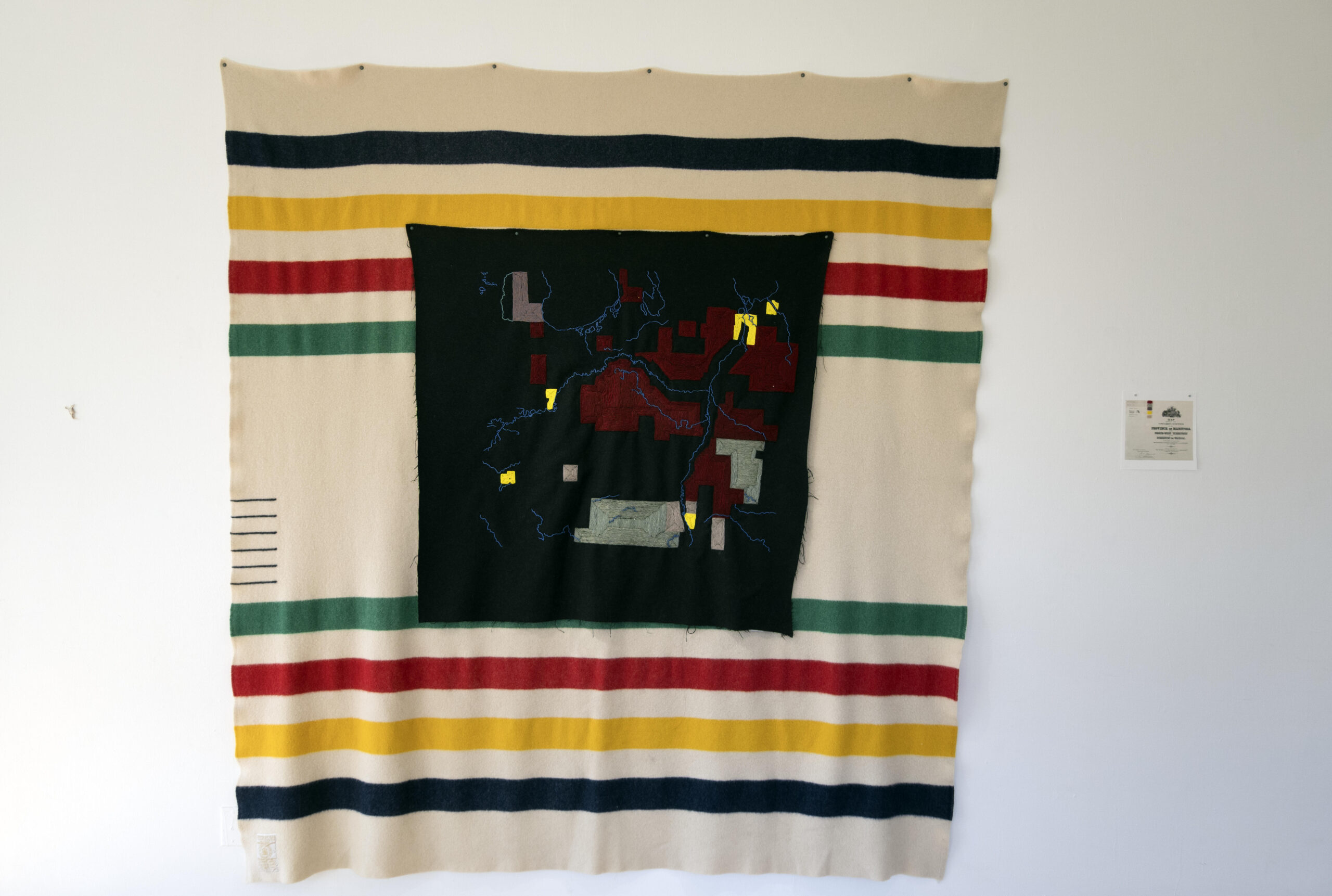
1,400,000. HBC Point Blanket, melton, beads, thread, antique upholstery tacks. 2025 Photo credit: Lilian Bonin
By Dan Cardinal McCartney
Sisterhood. Loss. Wear. Kinship. Bones. Light. Daughter. Photographs. Intentional. Soft. Unrelenting. Footsteps. Each word flickers through my mind during my conversation with artist Lilian Bonin. She graciously offered to guide me through her latest solo exhibition, Cartographie de Mémoire, only a couple of days after the reception attended by her family and members of the Winnipeg community. Similar to the long-distance phone calls I have with my relatives, our lively Métis laughter punctuates our conversation. As I’m in Mohkintsis (the Blackfoot name for Calgary, Alberta), she reminds me that Saint-Boniface is where her paternal family has lived, the Francophone city ward and neighbourhood, is widely known as the birthplace of Métis leader Louis Riel.
In her latest exhibition that traces personal and colonial histories, Bonin meticulously braids together collage, photography, painting, and installation. She overlays many of the media in beautiful moments of beadwork through interwoven and interrupted surfaces, encouraging the refracting of the natural light flooding in from the gallery’s windows. Bonin’s father did not acknowledge or celebrate his Métis heritage, as many Métis people in our families did out of survival. She turned to research and relationality, discovering generations of strong, resilient women in her lineage whose artistry lived in the tactility of objects such as beaded moccasins, bags, and mittens.
Upon entering the exhibition, Bonin invites viewers to interact directly with her collage vinyl piece, adhered to the gallery floor. The fragments of archival photographs of Métis women and text evoke images of thriving, abundant prairie land when viewed from an aerial perspective. Bonin’s last name appears in a poem, each word in French, which I can decipher as “the only one who looked like the Bonin is dead.” In our studio conversations months ago, Bonin described the prejudices she and her family endured when speaking their mother tongue, French. The absence of an English translation can be seen as the artist’s deliberate reclamation of her Francophone, Métis background.
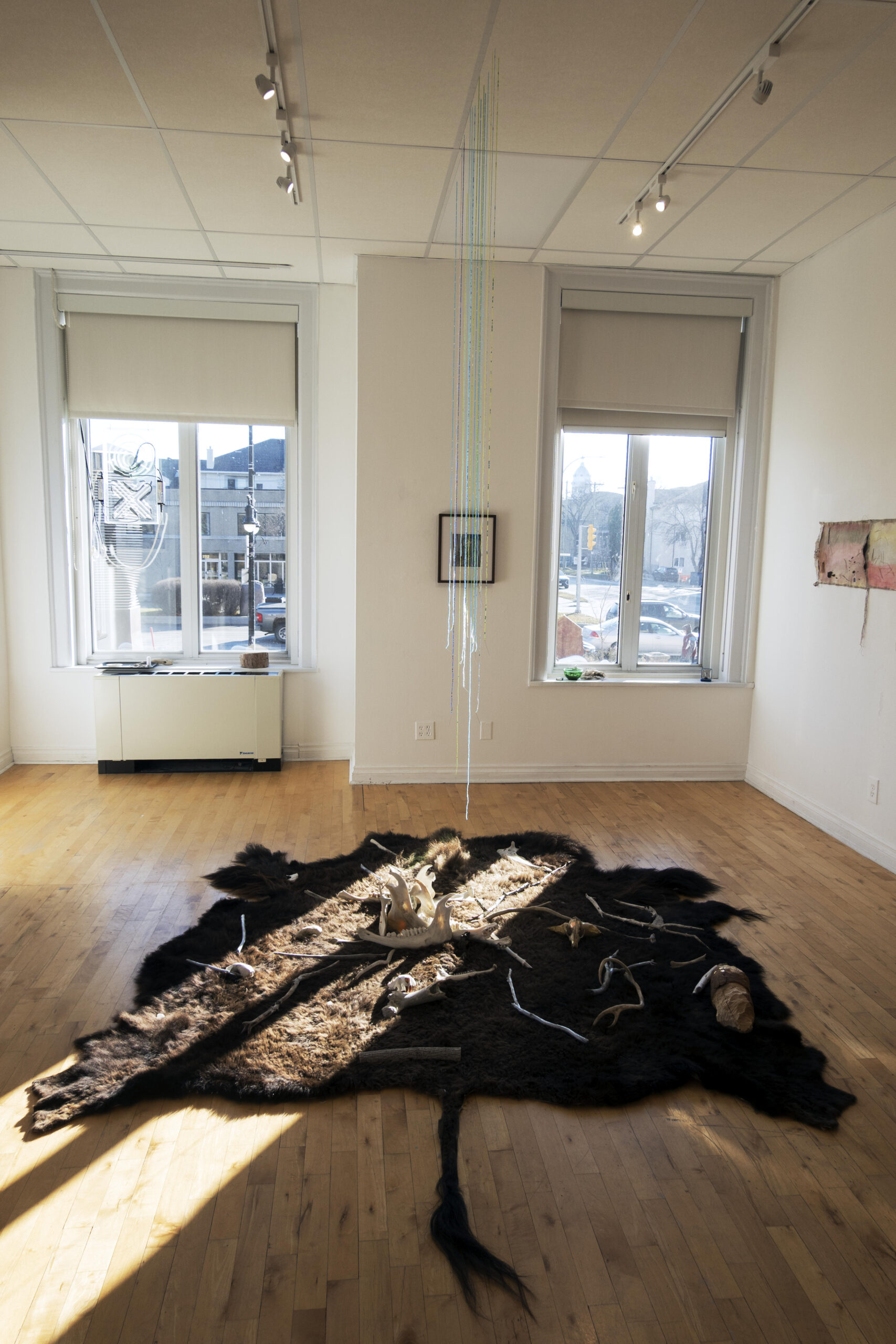
Reliquary, bison robe, bison jaw bones, racoon, fox and beaver skulls, gold and silver leaf on wood and animal bones, beaver chewed wood, beads, thread and needles. 2025 Photo credit: Lilian Bonin
One looks up to the gallery wall on the right, drawn to the familiar colonial pattern of a Hudson’s Bay Company blanket. Bonin layers a smaller, square-beaded map onto the blanket, describing it to me as a stamp. Rows of beads in different colours divide parcels of land among various communities, including her Métis family and ancestors, and she outlines the natural windings of river systems in deep blue beads. Bonin tells me this piece is the conceptual origin of the exhibition, created in 2020 during Manitoba’s 150th anniversary. The Premier refused to acknowledge the contributions of Métis people in the formation of the province, despite public pressure from the Manitoba Métis Federation. In response to this erasure, Bonin reversed the map in her beaded version. A red hue akin to blood signals the 1,400,000 acres of land designated as Half-Breed land, a promise never delivered.
Deeper in the gallery, a buffalo robe stretches across the floor. The installation reminds me of winter preparation, emphasized by a beaver’s skull resting amid animal jawbones and tree branches, objects gathered from her walks on the land. Beaded strands above the buffalo robe cast a soft shadow. This past summer, Bonin and I met during Kapishkum, the first residency of its kind for Métis artists at the Banff Centre for Arts and Creativity, located on Tunnel Mountain, referred to by the Îyârhe Nakoda as Sacred Buffalo Guardian Mountain or Sleeping Buffalo. Bonin initially aimed for at least fifty strands but instinctively stopped at eighteen for each cohort member. Early on, she remarked to me how energizing it was to witness younger people reclaiming their Métis roots and legacies. I felt equally ecstatic when meeting Bonin, appreciating her kind and insightful presence.
In the next gallery room, a series of hides stretches across the wall, collaged with layered photographs, printed textures, and beadwork. The hides evoke extended arms and bodies leaning, like riverbanks meeting. Embedded within these layers are references to Bonin’s great-grandmother’s land script. Nearby, a bird pelvis adorned with beads reminds me of the fragile sense of home under forced displacement, coupled with imagery of Métis people walking alongside their Red River wagons. On opposite walls hang prints of archival advertisements designed to attract settlers to ‘fruitful Manitoba,’ promising rich farmland for the taking. A nest with a small piece of birch bark is perched on a windowsill, accompanied by a tree-ring slab, its heartwood illuminated by autumn light.
Rounding the final corner, the artist reflects on how her projects often begin with an idea that feels distant, only to draw her inward with unexpected insistence. Bonin revisits her sister, who passed away too soon, in childhood, by stitching dark lines of her sister onto stretched, raw canvas. Her sister’s dark, precocious eyes stare back at me, the unfinished portrait honouring her unfinished story. Next to the portrait, a pair of tiny shoes is adhered to the gallery wall, each lace made from delicate, thin bead strands. A tiny white dress joins the two other pieces, with outstretched sleeves echoing the buffalo hides of the previous room. Delicately beaded flowers are stitched into the dress’s fabric; I choke up.
Respect is equated with remembering; in Cartographie de Mémoire, Bonin transforms intentionality into visual language, encouraging the viewer to reflect on their own as they walk the land. Her work reflects a dedicated approach to artmaking, foraging for materials in Saint-Boniface and Manitoba while exploring familial and cultural archives. I see her exhibition not as a conclusion on this specific body of work, but as a continuous hum of shifting and returning memories centring on her paternal lineage. However, it is the matriarchs, including Bonin, who stitch memory lovingly and carefully together. As my time with Bonin wraps up, I remember the words: Sisterhood. Loss. Wear. Kinship. Bones. Light. Daughter. Photographs. Intentional. Soft. Unrelenting. Footsteps.
Reference
May-Kosiewski, Alison. “Description as an Act of Othering: Towards Decolonizing Canadian Photo Archives.” The iJournal 10, no. 1 (Fall 2024): 120–138.
Acknowledgement: This article (Transforming Intention into Visual Language) was originally written as part of the partnership between ICCA and Rungh Magazine. As part of our long-term collaboration, ICCA offers writing opportunities for our community members while highlighting BIPOC exhibitions and programming in Rungh.
Lilian Bonin is a multidisciplinary artist. She responds to the world through painting, photography and beading. She collects fragments of humanity and nature and transforms them into metaphors for the human experience. In her practice Lilian seeks the unexpected and values the process of discovery in her art making. She is currently exploring the idea of “Canadian identity” in relation to land and memory. Her last exhibition Mapping Memory at the Maison des Artistes in Winnipeg, explored memory and land in relation to family and scrip.
Lilian has exhibited her visual narratives in Canada and France. Her work is held in permanent and private collections, included in books and used in movie shoots. She obtained a thesis BFA, first class honors in photography at the University of Manitoba and is the recipient of several Manitoba Arts Council and Canada Council Grants. She is proud of her francophone Red River Metis roots, (St, Annes Mb) and her Swiss descent. Lilian maintains an active studio and resides in Winnipeg, Manitoba.
 Dan Cardinal McCartney (he/him) is an interdisciplinary artist and curator who holds a Bachelor of Fine Arts from AUArts (2016) in Drawing. Most importantly, they are a full-time caregiver for their sister, Karri. Dan is of Athabasca Chipewyan First Nations with family ties of Mikisew Cree, Metis, and mixed settler lines from Treaty 8 territory, specifically Fort Chipewyan. He was raised in foster care in the northern boreal region of Fort McMurray.
As a Two Spirit transgender artist, Dan sifts through patterns of intergenerational trauma. He relates his personal, ongoing reconnection with his family to his yearning for gender euphoria through storytelling. Dan focuses on mixed media collage, painting, moving images, and performance. He is interested in the horror genre through a contemporary Indigenous lens. Currently, Dan works at Stride Gallery in in so-called Calgary, Alberta.