Stories Within Stories
Stories Within Stories
Requiems: Jim Logan
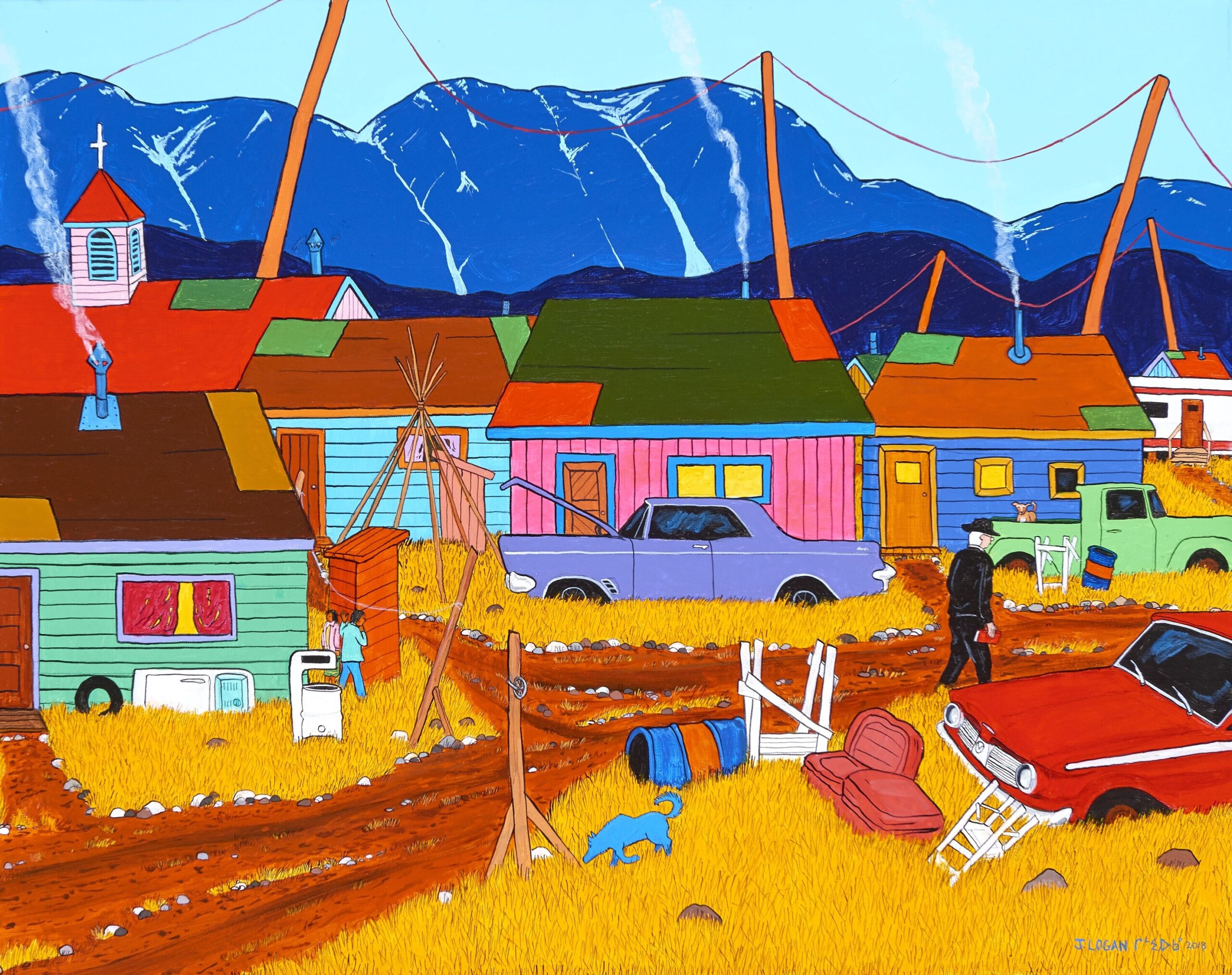
Hiding From the Boogeyman (2018) Acrylic on canvas Jim Logan
By Stefan St-Laurent
In literary and visual criticism, mise en abyme describes a structure in which an image or narrative is embedded within another, sometimes repeating in a seemingly endless sequence. In Requiems: Jim Logan, this recursive structure becomes both method and message. Across more than four decades, Logan has built a body of work that places one narrative inside another: Renaissance frescoes reframed through Indigenous cosmology; canonical European paintings re-staged on Turtle Island; biblical parables retold through the lived realities of residential schools, assimilation, resistance and survival.
Logan once described himself wryly as “a social statement artist.” [1] Yet his statements are never cut and dry; they are layered and often ironic, holding grief and humour in the same breath. His work invites viewers to recognize familiar compositions, only to destabilize them as the frames of reference begin to shift.
This strategy becomes particularly visible in Logan’s early 1990s paintings, where art history itself becomes the stage for intervention. In A Re-Thinking on the Western Front (1992), Logan directly cites imagery from Michelangelo’s Creation of Adam (c. 1511). Here, however, the Eurocentric biblical scene undergoes what Allan J. Ryan describes as a “splendid act of celestial inversion.” [2] The Creator is imagined as matriarchal and Indigenous, enthralled by Raven/Thunderbird and gesturing assertively toward a reclining Indigenous Adam resting upon the back of Turtle Island. Surrounding evolutionary diagrams and handwritten annotations question Western narratives of progress.
Logan’s The Diner’s Club (No Reservation Required) (1992) similarly reworks Édouard Manet’s Le Déjeuner sur l’herbe (1863), itself a knowing citation of Renaissance art. Manet’s modern picnic scandalized Paris for collapsing mythological nudity into a contemporary setting. Logan pushes this collapse further. Indigenous presence displaces colonial spectatorship altogether. The title—The Diner’s Club (No Reservation Required)—is double-edged: a wry reference to the exclusive credit card granting priority restaurant seating, and a cutting reminder of the reservation system imposed through the Indian Act of 1876.
The work operates as a layered narrative in which one painting reflects another, revealing how art history itself constructs meaning and visibility. Each layer exposes how art history has framed—and excluded—Indigenous bodies.
Curator Richard William Hill elaborates: “The figures are signalled as Indigenous both by physical appearance and cultural signifiers, such as the thunderbird tattoo on the man’s chest or the pipe that lies by his side. Just as striking is the reversal of assumptions about gender and the extent to which bodies are and are not open to the viewer’s gaze. In Manet’s painting a nude woman picnics on the grass with a group of fully clothed men. In Logan’s the men are nude and the women clothed. The picnic food is a mix: traditional items such as blueberries sit alongside cans of diet soda. This is a dichotomy-breaking reversal of the long-standing assumption that Indigenous tradition must remain discrete from contemporary life or risk contamination.” [3]
Logan continues this dialogue with Manet in Olympian (1992), a transformation of Manet’s Olympia. The reclining figure is draped across a Hudson’s Bay blanket, returning the viewer’s gaze with equal defiance. Yet the historical weight of the fur trade and colonial exchange now haunts the composition. What was once read as a modernist scandal becomes an indictment of settler exploitation and colonial violence.
In Christ Entering Great Plains Culture (1992), Logan references Giotto di Bondone’s Entry into Jerusalem (c. 1305). A Chief in Plains-style headdress appears among the gathered crowd; Christ carries an eagle feather in what may be read as a gesture of peace or conciliation. Giotto’s humanism—his attention to gesture and emotion—finds an echo here, yet the theological authority of the scene is unsettled. Christianity is refracted through Indigenous cosmology and the fraught history of missionary contact, making the biblical narrative inseparable from the history of church-run residential schools.
Logan’s strategy of historical inversion reaches a stark clarity in The Death of Bigfoot (1993), which reconfigures Benjamin West’s The Death of General Wolfe (1770). The fallen British general of the Plains of Abraham becomes Miniconjou Lakota Chief “Big Foot” (Spotted Elk), killed in the 1890 Wounded Knee Massacre. The lone Indigenous observer in West’s original composition is replaced by a settler military figure. The colonial tableau is inverted.
These gestures exemplify mise en abyme as a political method. Each painting contains another painting, which in turn holds another history. The recursion accumulates, layering references that steadily challenge the myth of a singular colonial narrative. The influence of Logan’s practice on subsequent generations of Indigenous artists cannot be overstated, including figures such as Kent Monkman and Christian Chapman.
If The Classical Aboriginal Series confronts the art historical canon, A Requiem for Our Children confronts the institutions that sustained colonial power: the church and the state. First exhibited in 1990 in Whitehorse—before residential schools were widely acknowledged in public discourse—the series gathers testimony and memory into unsettling tableaux. Logan did not attend residential school himself; he has spoken of being “blessed/cursed with a sensitive heart,” [4] a sensibility that has led him to advocate for survivors of residential schools. The works emerged from interviews, stories and fragments of lived experience, including his own catechism education in Port Coquitlam, as he sought to understand what lay beyond the surface.
In the work Night Visit, a priest kneels beside a child’s bed, one hand covering the boy’s mouth and the other his genitals. The child’s-eye perspective collapses distance, placing the viewer inside the room. These paintings are not allegories but acts of witnessing—visual memorials created long before the language of reconciliation entered national discourse.
Logan has questioned that language directly. “As it stands, I don’t think the word ‘reconciliation’ was meant for us,” [5] he has said, suggesting the term was often deployed to absolve colonial settlers. His later Reconciliation works do not offer closure; they trace the ongoing pathos of living, as he describes it, under hegemonic conditions.
Also from A Requiem for Our Children, The Pee Parade depicts Indigenous girls who had wet their beds being publicly shamed, forced to parade past nuns and classmates with yellow-stained sheets draped over their heads. Rather than turning a blind eye to such disturbing accounts, some churches invited Logan to present the series in sacred spaces, including Gloria Dei Lutheran Church in North Vancouver, confronting this history and acknowledging a measure of responsibility.
Born in 1955 in New Westminster, British Columbia, and of Métis ancestry, Logan spent formative years in Whitehorse, where he co-founded the Society of Yukon Artists of Native Ancestry and later became the first Indigenous curator at the Art Gallery of Nova Scotia. His advocacy extended to national institutions; he lobbied the National Gallery of Canada to recognize contemporary Indigenous artists more fully, meeting with then-director Pierre Théberge alongside colleague Louise Profeit-LeBlanc. The impact of this meeting had repercussions that can still be felt today.
The North—its communities, its hardships, and its sacred relationship to land—remains central in many of Logan’s works. As he reflected in 2021, much of his career has been devoted to “revealing the truth behind Indigenous communities… a continued study of the northern Canadian Indigenous experience.” [6] His paintings offer glimpses of the difficult living conditions he witnessed between the 1960s and 1990s. Yet the gravity of these subjects is often threaded with irony.
At the heart of Logan’s practice lies storytelling—not storytelling as illustration, but storytelling as structure. The oral traditions of First Nations and Métis communities provide a crucial framework for understanding how his paintings function. Within many oral traditions, stories function not as fixed artifacts but as living forms of knowledge passed between generations. They are told and retold, adapted to context, carrying teachings across time. Meaning accumulates through repetition but also through variation and subversion.
Rather than presenting a single closed narrative, Logan’s works often unfold as episodes within a larger continuum. Handwritten annotations appear in certain compositions, echoing the voice of a storyteller pausing to clarify or emphasize a point. The influence of oral storytelling also shapes his use of humour and irony. Trickster narratives—central to many Indigenous storytelling traditions—employ wit, inversion and satire to expose imbalance and challenge authority. Logan’s reworkings of canonical European paintings, his playful yet cutting titles, and his strategic reversals of colonial iconography all operate within this logic. Power is unsettled through a narrative shift.
Logan’s critical perspective comes into focus through titling: He Stole 3 Boxes of Kraft Dinner, Hiding From the Boogeyman or They Stole My Sister. Oral tradition does not separate the spiritual, the historical and the everyday. Stories weave cosmology, moral teaching, community memory and lived reality. In Logan’s work, biblical imagery sits alongside contemporary Indigenous life; art history converses with residential school testimony; humour coexists with grief. His paintings do not compartmentalize experience—they hold it all in relation. In this way, his visual language can be understood as an extension of oral practice into paint. The canvas becomes a site of transmission.
Jim Logan’s aesthetic has at times been compared to “folk” or “outsider” art—terms often attached to artists who employ bold colour, rough figuration, or scenes drawn from everyday life. His saturated palette—electric blues, scarlet reds, acid greens—serves as an entry point. The “chromatic intensity that carries emotional charge” [7] immediately captures the eye, disarming viewers through pleasure before confronting them with difficult truths.
Yet the “outsider” label carries historical baggage. It has often been used to romanticize and diminish artists falsely perceived as naïve or untouched by intellectual discourse. When applied to Indigenous artists, the term reproduces racist tropes—implying that Indigenous expression exists outside theory, institutional knowledge or strategic intent. Logan’s work decisively refutes these assumptions. His paintings are conceptually driven. They interrogate nationalism, religion, colonial violence and art historical authority. They deploy humour as a political tool, citation as critique, and colour as a decoy. Rather than existing outside the story of Western art, Logan inserts Indigenous presence directly into its centre.
Logan himself spent nearly two decades working within Canada’s arts institutions, serving as a program officer for artist-run centres at the Canada Council for the Arts. In accordance with the council’s conflict-of-interest policy, he was unable to exhibit widely at publicly funded institutions during that period—a limitation that significantly affected his visibility and recognition as a contemporary artist. This did not, however, diminish his productivity. This exhibition seeks to bring renewed critical attention to his work by presenting the most comprehensive survey of his artistic production to date.
Groundbreaking exhibitions such as Indigena: Perspectives of Indigenous Peoples on Five Hundred Years (1992) at the Canadian Museum of History, curated by Gerald McMaster and Lee-Ann Martin, and The World Upside Down (2006) at the Walter Phillips Gallery, curated by Richard William Hill, were pivotal in bringing Logan’s work to broader public awareness.
The exhibition title Requiems: Jim Logan draws from both the liturgical and musical requiem mass for the dead—a structured and powerful act of remembrance. In Logan’s practice, there is no singular elegy but many: for children, for language, for land and for dignity. Reflecting on his work, Logan states, “I hope that by painting the stories, it will help to begin healing. Our whole society is in need of such healing.” [8] His words suggest that the exhibition extends far beyond a collection of paintings, functioning instead as a site of commemoration, restoration, and perhaps even reconciliation.
Notes
1. Jim Logan and Leah Snyder, “Dialogue(s) with Jim Logan and Leah Snyder,” Canada Council Art Bank, online, July 9, 2024, https://artbank.ca/blog/2024/7/dialogues-with-jim-logan.
2. Allan J. Ryan, The Trickster Shift: Humour and Irony in Contemporary Native Art (Vancouver: UBC Press, 1999).
3. Richard William Hill, “Drag Racing (Dressing Up White) and the Canon Upside Down: Inversion in Contemporary Art and Visual Culture,” in The World Upside Down (Banff: Walter Phillips Gallery, 2008).
4. Douglas Todd, “Schools of Suffering and Shame,” The Vancouver Sun, Saturday Review section, November 3, 1990.
5. Ibid.
6. “A Native Perspective: The Eye-Opening Work of Jim Logan,” Reader’s Digest Canada, 2021.
7. Ibid.
8. Douglas Todd, “Schools of Suffering and Shame.”
Acknowledgement
“Stories Within Stories” is the curatorial essay for the exhibition Requiems: Jim Logan (May 1–August 15, 2026), which offers the most comprehensive survey of Jim Logan’s work to date. Curated by Stefan St-Laurent, the exhibition is presented by SAW with support from Ottawa 200, in association with the exhibition Qillaniq (June 12–September 30, 2026) at the National Gallery of Canada.
 Jim Logan (born 1955) is a seminal Métis painter whose practice serves as a poignant visual record of what he terms the “Quiet Condition”—the overlooked, everyday realities of Indigenous life. Based in Ottawa, Logan’s work is defined by a “faux-naïve” aesthetic, using vibrant palettes and bold outlines to navigate themes of cultural resilience, the legacy of residential schools, and the complexities of reconciliation.
His career is marked by a deep commitment to subverting the Western canon. In his acclaimed Aboriginal Classical Series, Logan reimagined European masterpieces through an Indigenous lens, asserting space for his community within global art history. Beyond the studio, his influence extends to his former role as a Visual Arts Program Officer at the Canada Council for the Arts and his founding membership in the Eastern Aboriginal Artist Collective. A recipient of the King Charles III Coronation Medal and an Honorary Doctorate from OCAD University, Logan’s work is held in the permanent collections of the National Gallery of Canada and the Canadian Museum of History.
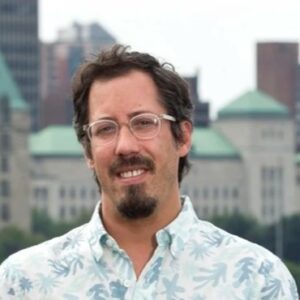 Stefan St-Laurent, multidisciplinary artist and curator, was born in Moncton, New Brunswick, and lives and works in Gatineau. He was the invited curator for the Biennale d’art performatif de Rouyn-Noranda in 2008, as well as for the 28th and 29th editions of the Symposium international d’art contemporain de Baie-Saint-Paul in 2010 and 2011. From 2002 to 2011, he served as Curator at the artist-run centre SAW in Ottawa and has been an adjunct professor in the Department of Visual Arts at the University of Ottawa since 2010. His performance and video work has been presented in numerous galleries and institutions, including the Centre national de la photographie in Paris, Edsvik Konst och Kultur in Sollentuna (Sweden), YYZ Artists’ Outlet in Toronto, Western Front in Vancouver and the Art Gallery of Nova Scotia in Halifax. He has also worked as a curator and programmer for a range of artistic organizations and festivals, including the Lux Centre in London, the Cinémathèque québécoise in Montréal, the Festival international du cinéma francophone en Acadie in Moncton, the Rencontres internationales Vidéo Arts Plastiques in Basse-Normandie (France), as well as Pleasure Dome, the Images Festival of Independent Film and Video, and Vtape in Toronto. He was Director of the artist-run centre AXENÉO7 in Gatineau from 2014 to 2019 and is currently Artistic Lead, Special Projects, at SAW.
Share This Article

Written by : Publications
Follow Us on Social Media
Join our Membership

October 22, 2026
October 22, 2026