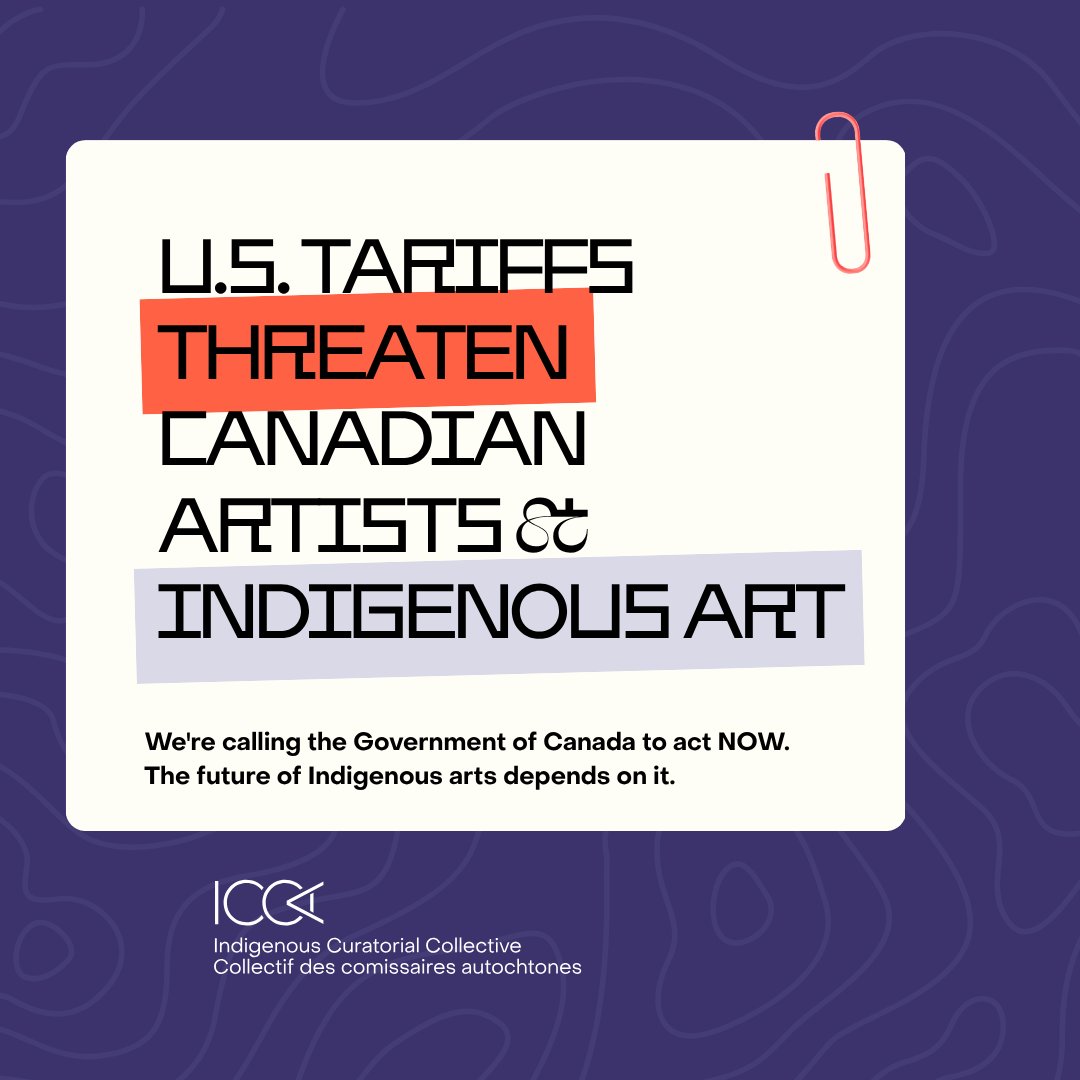
Proposed U.S. Tariffs Threaten Canadian Artists and the Circulation of Indigenous Art

FOR IMMEDIATE RELEASE
Proposed U.S. Tariffs Threaten Canadian Artists and the Circulation of Indigenous Art
ICCA and the Visual Arts Alliance calls for immediate federal action to protect artists, galleries, cultural organizations, and Canada’s visual arts marketplace
Ottawa, Ontario — August 10th, 2026
ICCA and The Visual Arts Alliance (VAA) is calling on the Government of Canada to respond to the additional 50% tariffs announced by the United States on a wide range of Canadian goods, including original artworks and materials used by Indigenous artists.
The tariffs are scheduled to take effect on August 19, 2026. The published list includes:
- Paintings, drawings, pastels, and collages
- Original prints and lithographs
- Sculptures and jewellery
- Textiles, wood products, and other handmade works
- Raw furskins, fur products, hides, and skins
- Bone, whalebone, horn, antler, hooves, claws, and beaks
The inclusion of original artworks and materials used by artists is a serious concern for Canada’s visual arts communities.
Indigenous artists work across contemporary, interdisciplinary, and customary practices, using materials that range from paint, textiles, wood, fur, hide, bone, and antler to photography, installation, sculpture, and mixed media. Tariffs that increase the cost of exhibiting, transporting, or selling these works in the United States could limit artists’ economic opportunities, restrict international circulation and exchange, and reduce the visibility of Indigenous art within the broader contemporary art sector.
Although the tariffs are framed as trade measures, their effects will extend across Canada’s cultural sector. Indigenous artists, curators, galleries, museums, collectors, arts organizations, and Indigenous-owned businesses all contribute to the creation, exhibition, acquisition, and circulation of Indigenous art.
Increased tariffs and continued trade instability could:
- Reduce sales to U.S. collectors, museums, and galleries by making Canadian and Indigenous artwork more expensive in one of Canada’s largest export markets.
- Increase customs, brokerage, insurance, and transportation costs for artists, commercial galleries, and Indigenous-owned businesses participating in international exhibitions, art fairs, and sales.
- Discourage cross-border exhibitions and cultural exchange by increasing the cost of artwork loans, acquisitions, touring exhibitions, and temporary imports and exports.
- Reduce earned income for artists who already experience limited access to national and international markets because of geography, transportation costs, and the realities of living and working in northern and remote communities.
- Affect Indigenous businesses that rely on the sale of handcrafted jewellery, clothing, carvings, textiles, and cultural works made with traditional materials.
- Create uncertainty for museums, public galleries, universities, and collectors acquiring Indigenous artwork for exhibitions, research, public programming, and permanent collections.
Trade between Canada and the United States is central to the health of Canada’s cultural economy. According to Statistics Canada, Canada exported $27.1 billion in cultural products in 2023, with $18.1 billion, approximately two-thirds of the total, exported to the United States. Continued instability threatens artists’ livelihoods, weakens galleries and cultural businesses, and reduces opportunities for international exhibition and exchange.
The ICCA Calls on the Government of Canada to:
- Pursue an immediate exemption for original Canadian artworks and culturally significant materials from the additional U.S. tariffs.
- Provide targeted financial relief to artists, galleries, Indigenous-owned businesses, and cultural organizations experiencing increased costs, delayed shipments, cancelled sales, or lost exhibition opportunities because of tariffs and border disruptions.
- Establish an emergency support and stabilization program for visual arts organizations and businesses affected by ongoing Canada–U.S. trade instability.
- Make purchases of original Canadian art GST-exempt, recognizing Canadian art as both a cultural good and an important contributor to the national economy.
- Work with Indigenous artists and arts organizations to ensure that federal trade responses recognize the cultural significance of traditional materials and do not treat Indigenous cultural works solely as commercial commodities.
- Develop clear customs and border guidance for artworks, including temporary exports, touring exhibitions, loans, and returns, to prevent unnecessary delays and inconsistent treatment at the border.
Canadian art is not simply another category of merchandise. It carries cultural knowledge, history, identity, and relationships between communities. The Government of Canada must act quickly to protect artists’ livelihoods, sustain the organizations and businesses that support them, and preserve the international circulation of Canadian and Indigenous art.
About the Indigenous Curatorial Collective (ICCA)
The Indigenous Curatorial Collective / Collectif des commissaires autochtones is an Indigenous-run and Indigenous-led national arts service organization that supports and connects First Nations, Inuit and Métis curators, artists, writers, academics and cultural professionals. Through advocacy, professional development, mentorship, gatherings, partnerships and critical discourse, ICCA works to strengthen Indigenous authority, opportunity and self-determination throughout the arts and cultural sector.
– 30 –
Media contact:
Liz Barron
Director, Indigenous Curatorial Collective / Collectif des commissaires autochtones
Member of the Visual Arts Alliance
l.barron@icca.art
Share This Article