2026 Gathering & Delegation Initiative
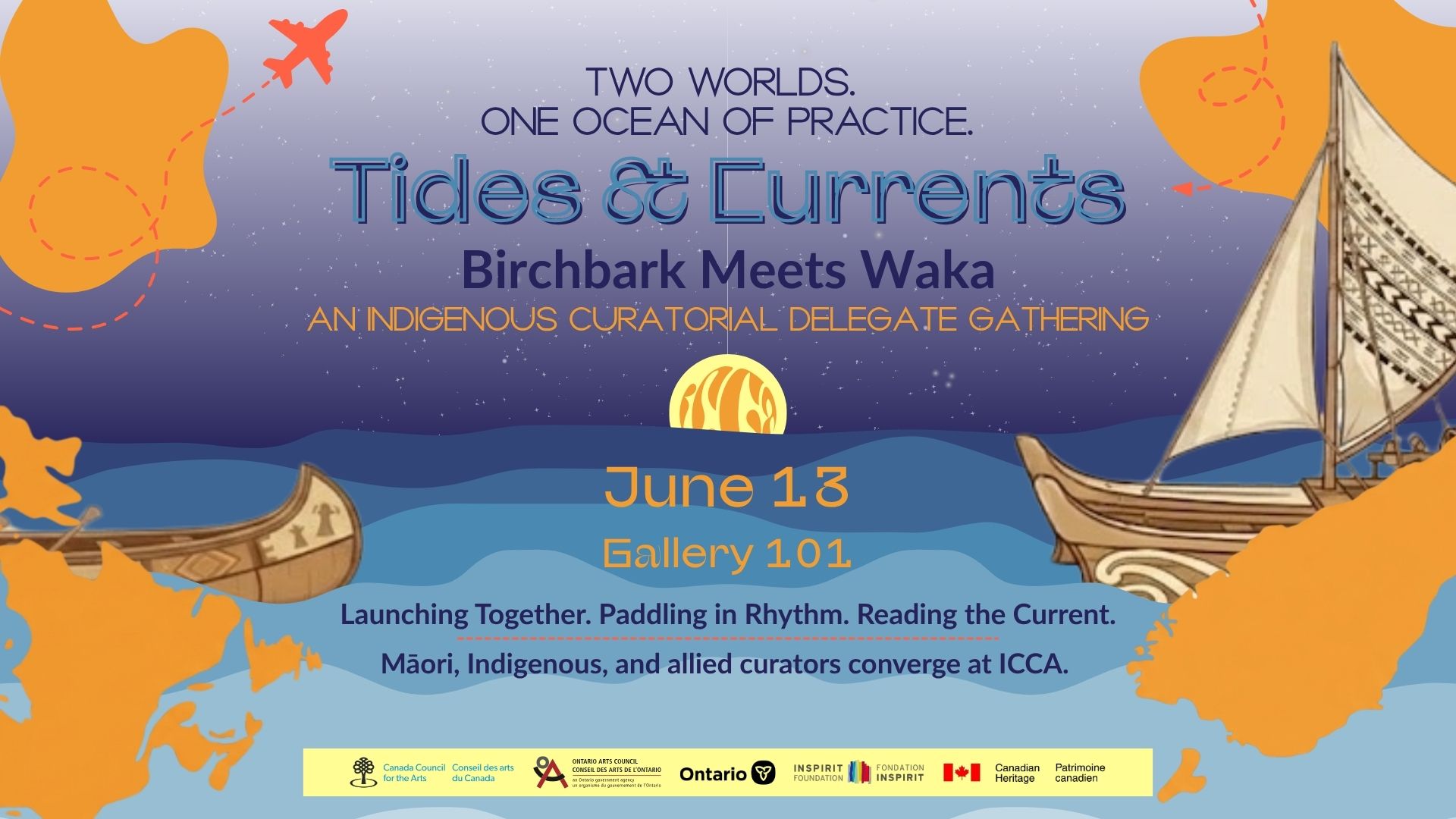
Tides & Currents: Birchbark Meets Waka

About the Program

The Indigenous Curatorial Collective (ICCA) is proud to host a landmark gathering in Ottawa, bringing together many curators, including those from ICCA x Pātaka Foundation Delegation Program, supported by Creative New Zealand, alongside Indigenous curators, artists, and writers from across Turtle Island. This exchange coincides with the opening of the National Gallery of Canada’s Indigenous Quinquennial, creating a global nexus for Indigenous-led curatorial leadership, radical joy, and institutional transformation.
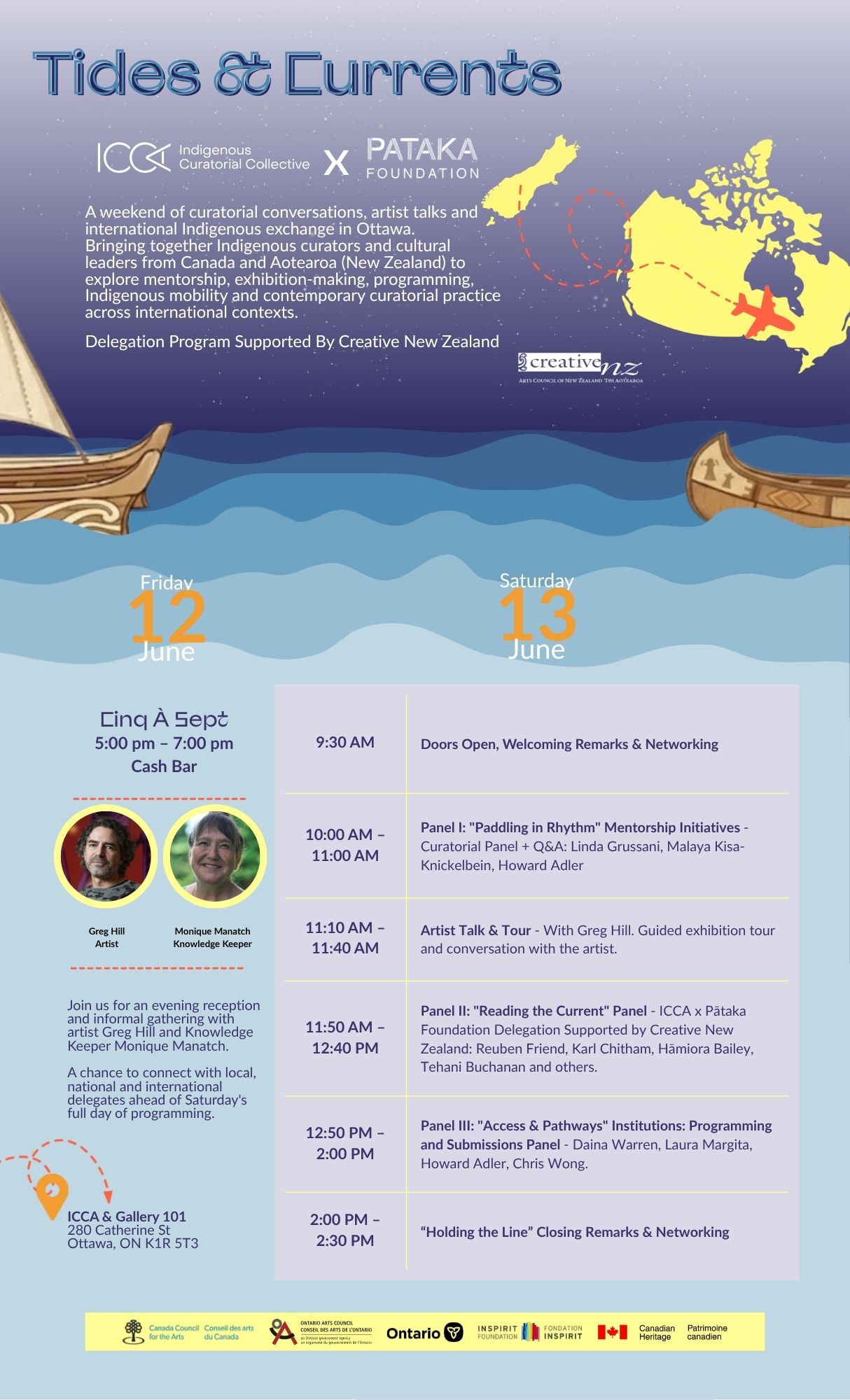
The Indigenous Curatorial Collective (ICCA), in partnership with the Pātaka Foundation and supported by Creative New Zealand, hosted an international delegation program in Ottawa, Ontario from June 11–14, 2026. The program brought together Indigenous curators, artists, cultural leaders, and arts administrators from Canada and Aotearoa New Zealand to participate in exhibitions, public programming, professional development, networking, institutional visits, and cultural exchange.

The delegation was strategically scheduled to coincide with the opening of Qillaniq at the National Gallery of Canada, creating opportunities for delegates to engage with Indigenous artists, curators, writers, and cultural leaders gathered in Ottawa from across Canada and internationally.

Through exhibitions, panel discussions, artist talks, site visits, shared meals, and informal gatherings, participants explored contemporary Indigenous curatorial practice, mentorship, exhibition development, cultural leadership, and future opportunities for collaboration.

The program achieved its objectives of fostering Indigenous-led cultural exchange, strengthening international curatorial networks, supporting professional development, and creating relationships that continue beyond the formal event dates.

0
Cities
0
NZ Delegates
0
Attendees

National Gallery Of Canada

A key component of the delegation experience was participation in the opening of Qillaniq, a major international Indigenous art exhibition at the National Gallery of Canada. Curated by an all-Indigenous curatorial team from across the circumpolar world, the exhibition features work by nearly seventy artists and represents one of the most significant Indigenous art exhibitions presented in Canada in recent years.

Delegates attended the exhibition opening, reception, and catalogue launch events, providing opportunities to engage with artists, curators, writers, and cultural leaders gathered in Ottawa for the exhibition. The opening served as an important networking event and helped situate the ICCA × Pātaka Foundation Delegation Program within a broader international Indigenous arts context.

While delegates benefited greatly from attending the exhibition and related events, a dedicated tour or formal exchange with members of the curatorial team was not ultimately realized. ICCA Board member and Qillaniq curatorial team member Liisa-Rávná Finbog was unable to attend the opening in Ottawa, and key ICCA contact Michelle Lavalle was on short leave following a bereavement. Future delegation programs would benefit from structured opportunities for direct dialogue between international delegates and host institution curators.

Ottawa Public Programming

A central component of the ICCA programming was Greg Hill’s exhibition and performance project Onáket meets Waka, held at the ICCA Ottawa office / gallery space, housed in Gallery 101.

As part of the project, Greg Hill undertook a public performance procession moving the work Cereal Box Canoe from the Ottawa Art Gallery to the ICCA Cinq à Sept for the opening of the exhibition. The performance physically connected institutions and created opportunities for public engagement and reflection on Indigenous mobility, exchange, waterways, and relationship-building. Delegates portaged with Hill through Ottawa, and Hill presented each delegate with a canoe as a way to connect and remember.

Read Jason Baerg’s Text on this performance: Movement, Material, and Continuance

The ICCA hosted a public Cinq à Sept at Gallery 101 featuring artist Greg Hill and Knowledge Keeper Monique Monatch as part of the Onáket meets Waka exhibition and performance project.

67 participants gathered — delegates from Aotearoa New Zealand, Canadian artists, curators, cultural workers, community members, and representatives from arts organizations — for an evening of conversation, networking, and cultural exchange.

Knowledge Keeper Monique Monatch contributed reflections that grounded the gathering in Indigenous knowledge, community, and relationship-building. The event also attracted participation beyond the formal delegation, including two visiting Nordic curators whose presence further expanded the international scope of the gathering.

The curatorial roundtable featured seven Canadian presenters and four delegates from Aotearoa New Zealand participating across three panel discussions.

Canadian Presenters

  • Greg Hill, artist and PhD candidate
  • Linda Grussani, curator and PhD candidate
  • Malaya Kisa-Knicklebein, curator / artist / traditional tattooist
  • Laura Margita, curator / director, Gallery 101
  • Daina Warren, curator
  • Chris Wong, programmer, Asinabka Film and Media Festival / DJ / artist
  • Howard Adler, programmer, Asinabka Film and Media Festival / filmmaker / chef

Aotearoa New Zealand Delegates

  • Reuben Friend
  • Karl Chitham
  • Hāmiora Bailey
  • Tehani Buchanan

Topics included Indigenous curatorial practice, exhibition development, mentorship, moving image programming, Indigenous-led institutions, international collaboration, and future opportunities for exchange. The quality of discussion was exceptionally strong and participants expressed interest in continued dialogue and future collaboration.

Institutional & Exhibition Visits

An important component of the delegation program was a visit to the Canada Council for the Arts and its Âjagemô exhibition space. The delegation participated in a guided visit led by Kitigan Zibi Anishinabeg artist Claude Latour, exploring contemporary Indigenous perspectives on territory, waterways, community, environmental stewardship, and place-based knowledge.

The visit also introduced delegates to the Canada Council Art Bank collection and its role in supporting, acquiring, stewarding, and circulating contemporary Canadian art. The experience provided valuable insight into Canadian arts infrastructure while grounding delegates in local Indigenous perspectives connected to Algonquin Anishinaabe territory and the Kichi Zībī (Ottawa River).

A significant highlight was a guided tour of the Jim Logan retrospective at SAW Gallery in Ottawa, led by the artist himself. Delegates identified many similarities between the colonial histories of Canada and Aotearoa New Zealand, and discussion emerged around Indigenous resistance, cultural continuity, representation, and identity.

Logan’s tour concluded with his iconic work Ten Indian Bars, followed by an invitation to visit one of the locations referenced within it — Ottawa’s historic Lafayette Tavern, known as “The Laff,” a longstanding gathering place for Indigenous artists, cultural workers, and community members. The combination of artist-led interpretation, critical dialogue, and shared social experience made this visit one of the most memorable components of the program.

Read Stefan St-Laurent’s Text on this exhibition: Stories Within Stories

The delegation also visited the Korean Cultural Centre exhibition as part of a broader exploration of international cultural presentation and exhibition practices. The visit prompted discussion regarding cultural diplomacy, exhibition design, audience engagement, and international approaches to presenting artistic and cultural work.

Relationship Building & Professional Exchange

One of the strongest professional relationships developed through the delegation program was between New Zealand curator Hāmiora Bailey and artist, curator, and former ICCA board member Jason Baerg. Following the Ottawa program, Jason hosted Hāmiora in Toronto and facilitated participation in a Human Rights Roundtable presented in partnership with Pride Toronto, gallery visits, meetings with artists and cultural organizations, and a visit to Niagara Falls.

This relationship demonstrates the long-term value of the delegation model — connections established through ICCA programming continue to generate meaningful opportunities for cultural exchange, mentorship, and collaboration well beyond the formal program dates.

Following Ottawa, members of the delegation travelled to Montréal to continue engagement with Indigenous-led exhibitions and cultural organizations. Delegates Karl Chitham, Hāmiora Bailey, and Tehani Buchanan participated in a tour of daphne — an Indigenous artist-run centre in Montréal — led by ICCA staff member Amanda Ibarra. Karl Chitham was also able to meet artist Luke Parnell and view his exhibition presented at daphne.

The delegation’s Montréal activities continued with attendance at Skawennati’s public art launch at the Montréal Council for the Arts, creating additional opportunities for networking and engagement with Indigenous artists and cultural leaders working in Québec.

Additional evidence of the delegation’s impact emerged following the conclusion of the Ottawa program. Chris Wong, presenter and programmer with the Asinabka Film and Media Arts Festival, participated in delegation activities and continued conversations with participants following the gathering. During a subsequent meeting in Montréal at Skawennati’s public art launch, Wong reconnected with Hāmiora Bailey and members of the Māori delegation. Discussions regarding future collaboration quickly emerged, including participation in the next edition of the 2 Spirit Ball. These conversations represent a direct outcome of relationships established through the delegation program and demonstrate how Indigenous-led international exchanges can create opportunities for future artistic collaboration, cultural exchange, and community-building beyond the formal project period.

Feedback received from participants and presenters consistently highlighted the value of creating spaces for Indigenous-led exchange and relationship building. The development of new collaborative opportunities following the delegation illustrates the long-term impact of bringing together Indigenous cultural practitioners from different regions and nations and reinforces the importance of continued international exchange initiatives.

Former ICCA board member Léuli Eshrāghi extended invitations and networking opportunities throughout the week, further expanding the program’s reach and strengthening relationships across Indigenous curatorial and artistic networks.

A significant outcome of the delegation program was the role that shared meals played in relationship-building and cultural exchange. For Indigenous communities in both Canada and Aotearoa New Zealand, sharing food remains an important cultural practice that creates space for storytelling, knowledge exchange, and the strengthening of community connections. Many of the most meaningful discussions and future plans emerged during shared dinners, making food sharing an essential component of the delegation program rather than simply a hospitality activity.

Documentation, Publications & Legacy

The impact of the delegation program will continue beyond the in-person activities through ongoing documentation, writing, and publication.

  • Braided Nation documented Greg Hill’s performance procession from the Ottawa Art Gallery to the ICCA Cinq à Sept as part of the Onáket meets Waka project. The recording will be shared through ICCA digital platforms and newsletters.
  • Braided Nation also recorded Jim Logan’s presentation, creating an additional educational and archival resource.
  • The ICCA has commissioned an essay by Jason Baerg reflecting on the exhibition, performance, and broader themes explored through the delegation program, to be published through ICCA’s digital platforms and shared with members of the New Zealand delegation.

Successes

The ICCA × Pātaka Foundation Delegation Program successfully achieved its objectives of fostering Indigenous-led cultural exchange, strengthening international curatorial networks, and creating meaningful opportunities for professional development and relationship building between Canada and Aotearoa New Zealand.

Key outcomes included:

  • A strong multi-organization partnership between ICCA, the Pātaka Foundation, and Creative New Zealand that enabled sustained dialogue and exchange across multiple sites and institutions.
  • Delegate participation in the opening of Qillaniq at the National Gallery of Canada — one of the most significant Indigenous art exhibitions in Canada in recent years.
  • A Curatorial Roundtable featuring seven Canadian presenters and four Aotearoa New Zealand delegates, generating rich discussion on Indigenous curatorial practice, mentorship, and future collaboration.
  • Highly impactful artist-led experiences, including Greg Hill’s Onáket meets Waka performance and Jim Logan’s guided retrospective tour.
  • Extended programming in Montréal and Toronto that deepened relationships and expanded professional connections beyond the formal Ottawa schedule.
  • Video documentation and publication initiatives that extend the reach of the program beyond the in-person gathering.
  • Shared meals and gatherings that proved central to the most meaningful exchanges and future planning.

Challenges

The primary challenges related to scheduling and logistics rather than programming content. Participant feedback regarding the quality of programming, networking, and cultural exchange was overwhelmingly positive.

  • The delegation coincided with an exceptionally active period of Indigenous arts activity in Ottawa, creating a full schedule with multiple concurrent events and venues competing for participants’ time and attention.
  • The volume of activities across the city created scheduling pressures and occasionally limited opportunities for rest, reflection, and informal conversation between programmed activities.
  • Participants expressed interest in additional unstructured time for informal conversation, spontaneous networking, and personal exploration — some of the most valuable outcomes emerged through these informal moments.
  • A dedicated curatorial exchange with the National Gallery of Canada’s curatorial team was not ultimately realized, representing a missed opportunity for structured professional dialogue.
  • Balancing structured programming with participant autonomy remained an ongoing consideration across the international delegation format.

Recommendations

The following recommendations are offered to strengthen future iterations of the delegation program:

Conclusion

The ICCA × Pātaka Foundation Delegation Program successfully created meaningful opportunities for Indigenous cultural exchange between Canada and Aotearoa New Zealand. Through public programming, professional development, mentorship, shared meals, exhibitions, performances, institutional visits, and ongoing dialogue, the program strengthened international relationships and generated new opportunities for collaboration that continue beyond the formal event.

The relationships established during the gathering have already resulted in ongoing professional exchanges, exhibition visits, institutional introductions, and collaborative discussions across Ottawa, Montréal, and Toronto. The commissioning of an essay by Jason Baerg in response to Greg Hill’s Onáket meets Waka will further extend the reach of the delegation through publication and critical reflection.


The value of Indigenous-led international exchange extends well beyond scheduled programming. By creating opportunities for artists, curators, cultural workers, and community members to gather, share knowledge, and build relationships, the delegation fostered professional connections that continue to generate new opportunities for collaboration, mentorship, and artistic exchange between Canada and Aotearoa New Zealand.

The ICCA looks forward to continuing these conversations and strengthening the relationships established through this successful delegation program.

Curatorial Delegate Essays

Turtle Island Personal Reflection

by Tehani Buchanan

Stepping off the plane onto Turtle Island, I’m greeted by two pou whakairo (carved posts) at Vancouver Airport, with two First Nations tapestries suspended from the ceiling to my left. A welcoming sight on arrival. But I’m not naïve enough not to wonder-perhaps even slightly judge-whether this is part of the state’s tourism PR plan. How visible really are Indigenous people on this land? My background in education and language reclamation means I’ve developed a critical lens for bullshitary, with a starting position of: question everything.

Coming Soon!

by Hāmiora Bailey

Coming Soon!

by Karl Chitham
Curatorial Gathering Essays

Movement, Material, and Continuance
The Cereal Box Canoe

by Jason Baerg

Greg A. Hill’s Cereal Box Canoe is an evolving vessel for thinking through Indigenous presence, material transformation, and movement. The work gathers domestic consumption,  artistic adaptation, and cultural continuance in a form that is at once sculptural, performative,  and relational.

Stories Within Stories
Requiems: Jim Logan

by Stefan St-Laurent

In literary and visual criticism, mise en abyme describes a structure in which an image or narrative is embedded within another, sometimes repeating in a seemingly endless sequence. In Requiems: Jim Logan, this recursive structure becomes both method and message.

Partners
In partnership with Pātaka Foundation · Supported by Creative New Zealand

Thank you for partnering with ICCA to provide this programming.

Delegations

Delegations

The ICCA Delegations Initiative aims to foster international collaboration and cultural exchange by selecting a group of delegates to participate in various global engagements. These engagements are carefully selected to align with the goals and objectives of the ICCA, with the intention of sharing knowledge, experiences, and innovative practices.

The ICCA Delegations Initiative is a comprehensive program designed to promote international collaboration and cultural exchange. By meticulously planning each delegation and providing robust support to delegates, ICCA ensures a meaningful and impactful experience for all participants. The long-term vision of forming a panel and presenting at conferences underscores ICCA’s commitment to sharing knowledge and fostering global connections.