Movement, Material, and Continuance: The Cereal Box Canoe
Movement, Material, and Continuance
The Cereal Box Canoe
By Jason Baerg
Greg A. Hill’s Cereal Box Canoe is an evolving vessel for thinking through Indigenous presence, material transformation, and movement. The work gathers domestic consumption, artistic adaptation, and cultural continuance in a form that is at once sculptural, performative, and relational.

Figure 1. Greg A. Hill and Hāmiora Bailey share a hongi greeting inside the gallery beside the Cereal Box Canoe. Photograph by Tracey Lynne Photography.
The origins of Cereal Box Canoe are grounded in the everyday. Hill explained that the work emerged from thoughts initiated during an undergraduate radical ecology course and from a personal pledge to live a zero-waste lifestyle at a time when paperboard packaging was not recyclable where he lived. Before making the canoe, he had already transformed cereal boxes into customary objects including a headdress, moccasins (made in 2012), and a shoulder bag, as well as a dartboard. The canoe grew from this same commitment but gave that ethic a larger and more resonant form: a vessel shaped from the materials of domestic consumption and redirected toward cultural reflection, continuity, and critique.
Hill’s own artist statement sharpens that origin story in important ways. The canoe was made in 2000, and he notes that he constructed it while on parental leave for his son. He also writes that it was made entirely from materials found “within the boundaries of my yard,” including his saved collection of cereal boxes, a branch from the oak tree in the front yard, branches from the cherry tree, and other materials on hand. That yard-sourced material logic gives the work a remarkable intimacy: it begins not in abstraction, but in the physical ecology of family life, domestic space, and the immediate environment.
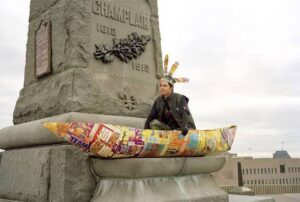
Figure 2. Greg A. Hill in his Cereal Box Canoe, Ottawa, Ontario, 2000. Photograph by Jeff Thomas.
Just as compelling is Hill’s description of the work’s surface language. He writes that the printed graphics on the cereal boxes created “a kind of consumptive self-portrait,” producing a contemporary pop aesthetic in tension with the historic cultural forms to which the material was being adapted. That phrase is crucial. It clarifies that the canoe is not merely made from recycled packaging; it is made from the residue of the artist’s own consumption, transformed into a sculptural form that reflects on systems of waste, identity, and survival. In that gesture, critique and self-implication are held together.
Hill’s reflections also position the canoe as more than an object: it is a conceptual device. During his master’s research at Carleton University, he wrote about the Two Row Wampum and contemporary artistic engagements with it. Conversations with Jeff Thomas helped extend that thinking, especially around the idea of moving through urban space in the vessel of one’s own culture. As Hill notes in his thesis, “Jeff Thomas and I would discuss movement through urban space in the vessel of one’s own culture” (Hill, 1998: p.147). At the same time, Hill was studying canoe histories and technologies through a major exhibition at the Museum of Civilization, now the Canadian Museum of History. In this context, the canoe becomes a method for thought as much as a sculptural form—an active way of navigating questions of coexistence, relation, and Indigenous continuity in the present.
Movement, in fact, is one of the work’s deepest structural principles. Cereal Box Canoe has never belonged exclusively to the gallery. It has been carried through streets, staged against monuments, and brought into relation with waterways and civic space. The 2005 performance documentation preserves this in the title Portaging Rideau, Paddling the Ottawa to Kanata, making clear that the canoe was activated as an embodied journey as much as a sculptural object. Through such gestures, Hill reasserts Indigenous presence within spaces too often framed by colonial commemoration and public amnesia. Click here for the 2005 performance video: https://www.youtube.com/watch?v=W-1_N9ZIJPM.
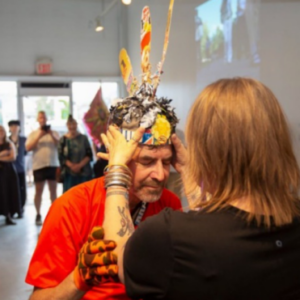
Figure 3. Hill’s Kahstowa being activated with curator Liz Barron during opening performance of Onáket Meets Waka.
That performative life continues in more recent activations. In June 2026, Onáket Meets Waka brought the canoe into dialogue with visiting Māori curators and a broader field of Indigenous exchange, welcome, and relationality. Here the canoe’s meanings expanded again: it became not only a reflection on material adaptation, but also a site for ceremony, greeting, and trans-Indigenous encounter. The work’s power lies partly in this capacity to remain open—to be anchored in specific histories while still able to enter new conversations, new responsibilities, and new publics.
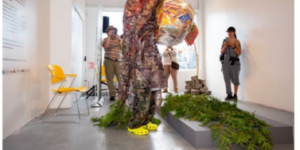
Figure 4. Hill concluding the portage of the canoe from the Ottawa Art Gallery and placing it on display at Gallery 101.
One of the most revealing responses to the work has long been the question, “Does it float?” Hill notes that the Western preoccupation with an object’s utility often blinds viewers to its aesthetic value—a bias that heavily compromises the reception of Indigenous art. The canoe did function in performance, but its significance exceeds proof-of-use. What Cereal Box Canoe insists upon is that Indigenous making has always involved adaptation: available materials are shaped through knowledge, context, and necessity. In Hill’s hands, paperboard, wood, twine, tar, and urethane do not parody tradition; they extend it into the conditions of contemporary life.
Hill also reflects on how public reception has changed over time. In 2005, before cellphones, he recalls a more direct and immediate form of public curiosity, one in which people followed the performance physically through the city. By 2026, attention had become more fragmented, often filtered through phones and the quick capture of images for digital circulation. That shift matters because Cereal Box Canoe is a work deeply invested in presence: in walking, carrying, paddling, gathering, witnessing. Its meaning is not exhausted by documentation. It unfolds in the live and contingent encounter between body, object, audience, and place.
For Hill, ceremony and spontaneity are inseparable from that encounter. He describes actions shaped not by rigid scripting but by drumming, rerouting, interruption, chance interaction, and intuition. This is one reason the work remains so vital. It refuses to settle into a single interpretation or medium. It moves between sculpture and action, between galleries and street, between historic form and contemporary material, without surrendering its conceptual integrity.
Ultimately, Hill places Cereal Box Canoe within a longer horizon of responsibility. His reflections turn toward the future—toward seven generations, toward the possibility that the work might continue to inspire artists and viewers not only as an object in a collection, but as an enduring proposition about sustainability, continuity, and Indigenous futurity. What the canoe carries forward is not nostalgia, but a way of thinking: that cultural forms remain alive precisely because they adapt, because they move, and because they continue to gather new meanings as they travel.
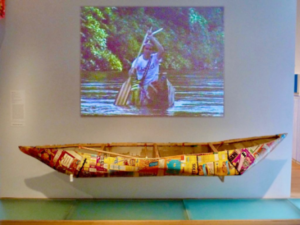
Figure 5. Greg A. Hill, Cereal Box Canoe installation with Portaging Rideau, Paddling the Ottawa to Kanata, performance video, Museum of Art and Design, NY. Photograph by Greg A. Hill.
Sources
Ottawa Art Gallery, permanent collection record for Greg A. Hill, Cereal Box Canoe (2000), accession 2005.11.01a-c. Online at https://oaggao.ca/learn/collections/permanent/2005-11-01a-c/.
Greg A. Hill, artist statement for Cereal Box Canoe (2000): paperboard, wood, twine, tar, and urethane; 322.6 x 45.1 x 71.1 cm; constructed on parental leave from materials found within the boundaries of his yard.
Greg A. Hill, interview with Jason Baerg, transcript of July 10, 2026, meeting (Teams recording, 46m33s). Underlying URL: https://www.genspark.ai/api/files/s/rJuubPWV.
Indigenous Curatorial Collective / The L. Project, presentations and publications page citing the C Magazine review of Greg A. Hill’s Cereal Box Canoe (2005) and the accompanying performance footage Portaging Rideau, Paddling the Ottawa to Kanata (2005). Online at https://thelproject.ca/presentations-publications/.
Rebecca Basciano, “Crafted from the Land: Anishinābe Chīmānikewin Along the Kichi Sibi,” in Àdisòkàmagan / Nous connaître un peu nous-mêmes / We’ll All Become Stories.
ICCA Presents Tides and Currents at Gallery 101, including Onáket Meets Waka, Gallery 101, Ottawa, June 12–13, 2026. Online at https://old.artengine.ca/community/calendar-event-en.php?id=16448.
Greg A. Hill, Re-investing the Kahswenta: Rotinonhsyonni identities today. MA Thesis, Carleton University, 1998. https://hdl.handle.net/20.500.14718/34246.
Greg A. Hill, Portaging Rideau, Paddling the Ottawa to Kanata, 2005. Click here for the 2005 performance video: https://www.youtube.com/watch?v=W-1_N9ZIJPM.
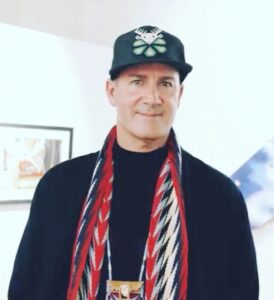 Jason Baerg is a registered member of the Métis Nations of Ontario and serves their community as an Indigenous activist, curator, educator, and interdisciplinary artist. Baerg graduated from Concordia University with a Bachelor of Fine Arts, a Master of Fine Arts from Rutgers University, and is enrolled in the Ph.D. program at Monash University. Baerg teaches as the Assistant Professor in Indigenous Practices in Contemporary Painting and Media Art at OCAD University. Exemplifying their commitment to community, they co-founded Shushkitew Collective and The Métis Artist Collective. Baerg has served as volunteer Chair for such organizations as the Indigenous Curatorial Collective and the National Indigenous Media Arts Coalition. As a visual artist, they push digital interventions in drawing, painting, and new media installation. Select international solo exhibitions include Canada House in London, UK, the Royal Melbourne Institute of Technology in Australia, and the Digital Dome at the Institute of the American Indian Arts in Santa Fe, New Mexico, USA. They have sat on numerous art juries and won awards through such facilitators as the Canada Council for the Arts, the Ontario Arts Council, and The Toronto Arts Council. For more information about their practice, please visit JasonBaerg.ca
Share This Article

Written by : Publications
Follow Us on Social Media
Join our Membership
October 12, 2026
October 12, 2026
October 12, 2026