Crafted from the Land: Anishinābe Chīmānikewin Along the Kichi Sibi
Crafted from the Land: Anishinābe Chīmānikewin Along the Kichi Sibi
By Rebecca Basciano
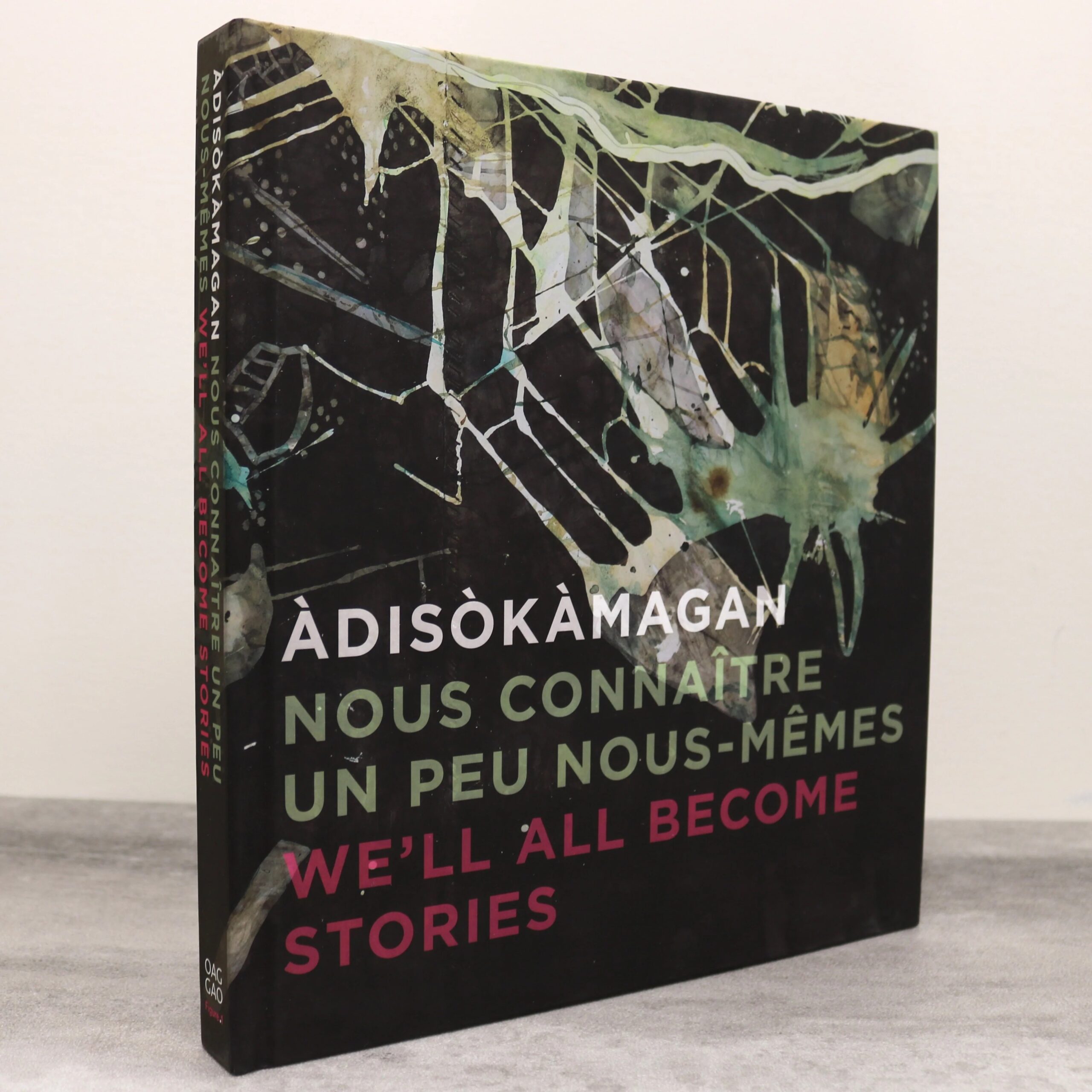
This essay chapter comes from the publication catalogue Àdisòkàmagan / Nous connaître un peu nous-mêmes / We’ll all become stories: A Survey of Art in the Ottawa-Gatineau Region, published by Figure 1 Publishing and the Ottawa Art Gallery officially in December 2017 (with retail distribution widely available in May 2018).
Developed by early Anishinābeg, the wigwàs chīmān (birchbark canoe) in the Ottawa-Gatineau region corresponds with the region’s fertile soils, perfect for the growth of some of the biggest wigwàs (white birch) and abundant rivers and lakes that were molded by the melting waters of the last Ice Age.¹ Lightweight and waterproof, wigwàs is the perfect material for building a vessel to navigate the region’s watercourses, whose passages are frequently interrupted by falls and rapids, necessitating many portages. An ingenious method of transport, the artistic and technological achievement of the wigwàs chīmān is inseparable from the geographical terrain of its material resources.
Long before the arrival of European colonizers, the wigwàs chīmān was entrenched in the cultural traditions of Indigenous groups who moved extensively throughout the region. Pictographs of canoes painted in red ochre by Anishinābe ancestors are found at the sacred site of Oiseau Rock, while archaeological evidence along the Kichi Sibi (Ottawa River) reveals tools such as migosan (awls)² and mōkodāganan (crooked knives),³ essential in chīmānikewin (birchbark canoe making).⁴ Shortly after encountering the Algonquin peoples, Samuel de Champlain adopted the wigwàs chīmān for his Imperial conquests up the Kichi Sibi.⁵ During the Beaver Wars and the fight for control over trade routes, the swift and quiet canoe was perfect for surprise attacks,⁶ and portage routes along the Kichi Sibi were the sites of toll stations and constant raids. With the economic growth of the fur trade, the wigwàs chīmān reached lengths of seven to twelve meters long,⁷ and was promoted as an iconic symbol of colonial prowess,⁸ as seen in paintings by Frances Anne Hopkins, and mythologized as a symbol of Canadian identity.⁹river like his Indigenous ancestors.
Over the years, the wigwàs chīmān has been supplanted by those made with cheaper materials and construction methods, although the craft and the techniques of chīmānikewin continue to be passed down through generations of Anishinābe canoe makers. In the twentieth century, renowned builders have included David Makakons, Vincent Mikans, Carlie Smith, William Commanda, James Jerome, Jocko Carle, Basil Smith, Patrick Maranda, John Ratt, and Daniel Sarazin, among many others. The construction of canoes also involves the creativity and labour of women, although their names are often omitted from the storytelling of chīmānikewin. Today, education can also be obtained from a replica of a fur trade canoe in the Canadian Museum of History,¹⁰ crafted by Matthew Bernard of Pikwakanagan in 1957, as well as interactive wigwàs chīmān workshops by contemporary makers such as Daniel Smith (Pinook) of Kitigan Zibi.
Traditional knowledge carried by master canoe makers and an understanding of how to source and shape materials into meaningful and practical forms should continue to be preserved. Scouting for materials, including the perfect wigwàs with a straight branchless trunk and a wide circumference, requires an intimate understanding of the landscape.¹¹ The construction itself is a reciprocal relationship between builders and their materials. Boiling water is poured onto the wood at many stages in order to induce pliability when bending the bark into shape or in sculpting the wāgināg (ribs)¹² and apadāpikahigan (gunwales).¹³ Precision with a mōkodāgan is also essential, especially in tapering the ends of the pīmidasā (thwarts)¹⁴ and wāgināg, while splitting the wood into apisidāganag (sheathing),¹⁵ and cutting the wadab (spruce roots) for lashings also requires a skilled hand. If desired, designs are scraped on the outside of the vessel and the canoe is completed after a sealant, often made from collected nodules of spruce sap, lard and grease, is applied.
In contrast to the traditional wigwàs chīmān, contemporary Kanyen’kehaka artist and curator Greg Hill crafted one from mass-produced materials. Cereal Box Canoe (2000) was also accompanied by a performance, where Hill portaged it from the Ottawa Art Gallery to the Ottawa River and then paddled it to Victoria Island. While a wigwàs chīmān is sculpted from the landscape, Hill’s canoe is a product of urban life and consumerism, illuminated when his portage route takes him through the Rideau Centre. With suitable wigwàs now harder to find, this piece emphasizes that the survival of traditional chīmānikewin depends on an ecological treatment of the land, which has been dramatically changed in this region due to logging and other industrial pursuits. Hill has instead reused consumer waste in order to spiritually and physically reconnect with the land and paddle down the river like his Indigenous ancestors.
Captions
Dan Sarazin Wigwàs Chīmān [birchbark Canoe / Canot En Écorce], 1970
Greg Hill Cereal Box Canoe [canot En Boîtes De Céréales], 2000 (Installation With Video Portaging Rideau, Paddling The Ottawa To Kanata [2005] / Installation Avec Vidéo Portage Rideau, Pagayage De L’outaouais Vers Kanata [2005])
 Rebecca Basciano, MA, is the Curator at the Ottawa Art Gallery, where she specializes in Canadian art. She has demonstrated interest in promoting the work of women artists, while also advocating for consistent representation. For the past six years, she has been curating exhibitions from the Gallery’s Firestone Collection of Canadian Art, including group shows featuring artists such as Yvonne McKague Housser, Kathleen Daly, Anne Savage, Marcelle Ferron, and Ghitta Caiserman. Her in-depth research on Frances-Anne Johnston is a natural continuation of this dialogue, delving deeper into reconsiderations and critiques of the art-historical canon.
Rebecca Basciano, MA, is a curator at the Ottawa Art Gallery, where she specializes in Canadian art. She is committed to promoting women artists and advocating for their equal representation. For the past six years, she has organized exhibitions of the Gallery’s Firestone Collection of Canadian art, including group shows featuring artists such as Yvonne McKague Housser, Kathleen Daly, Anne Savage, Marcelle Ferron, and Ghitta Caiserman. Her extensive research on Frances-Anne Johnston fits naturally within this dialogue and further explores the reconsideration and critique of historical art canons.
Photo credit: André Rozon
Share This Article

Written by : Publications
Follow Us on Social Media
Join our Membership

September 23, 2026

September 23, 2026