Turtle Island Personal Reflection
Turtle Island Personal Reflection
By Tehani Buchanan
Stepping off the plane onto Turtle Island, I’m greeted by two pou whakairo (carved posts) at Vancouver Airport, with two First Nations tapestries suspended from the ceiling to my left. A welcoming sight on arrival. But I’m not naïve enough not to wonder-perhaps even slightly judge-whether this is part of the state’s tourism PR plan. How visible really are Indigenous people on this land? My background in education and language reclamation means I’ve developed a critical lens for bullshitary, with a starting position of: question everything.
Canada has a complex imperial past, shaped by both French and English colonisation, and remains part of the British Commonwealth. (Btw, the Commonwealth Games are a perfect example of imperial PR scams that more people need to question!). According to my friend, who recently moved to Montreal, French-speaking Canadians-particularly in Quebec-are verrrryyy protective of their language. She tells me a story of a passionate debate between her and her ex about the need to protect French from English domination (his opinion).
I had downloaded Duolingo for a hot minute to learn a few French phrases to get me by, and was seriously considering revitalising my fifth-form French long-term. Instead, the woke part of my brain reminded me: “Do you need to learn another colonial language when your mother tongue is 50,000 kilometres away from your vernacular in Rarotonga?”
Yea nah. DELETE.
It was fascinating walking into a Montreal thrift store and listening to two shopkeepers converse in French before switching seamlessly into English, their thick Canadian accents suddenly appearing. I chuckled to myself: it’s like they can’t decide who they want as their coloniser.
Turtle Island, the Indigenous name used for the land area encompassing much of the North American continent, is a land mass so vast it would take 7 months of steady walking to walk across it or 33 years (!) to walk its entire coastline¹. It’s no wonder that Turtle Island is home to over a thousand diverse indigenous groups with their own distinct languages and customs. I have compassion for how incredibly difficult it must be politically, culturally and systemically to advance Indigenous self-determination across such a vast and diverse landscape, particularly when the colonisers think they’re the ones being colonised!
While here, we had the privilege of engaging with a number of Indigenous exhibitions and artists. To commune and wānanga with fellow First Nations kin, to see, listen and feel their experiences and artistry expressed through material and non-material forms, was an honour I want to acknowledge.
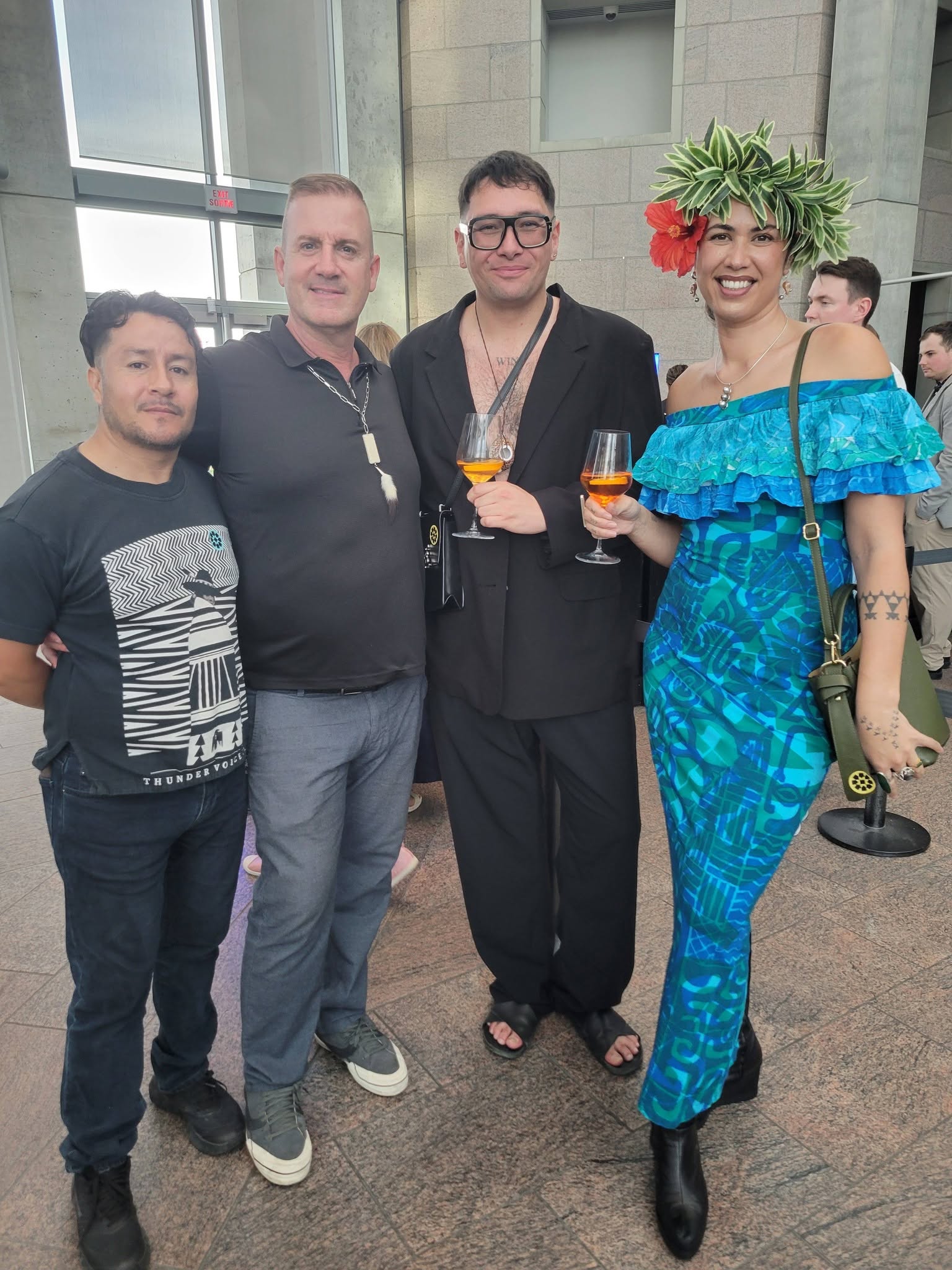
Left to Right: Anthony Rodgar, Jason Baerg, Hāmiora Bailey, Tehani Buchanan @ the National Gallery of Canada. Photography Credit: Liz Barron
Qillianiq
Qillianiq, situated on the unceded traditional territory of the Algonquin Anishinaabe Nation, is the largest exhibition of Indigenous circumpolar artists in the world. Curated by six Indigenous wāhine, Qillianiq-an Inuktitut word describing how light from the sun or moon shimmers brightly when reflecting on water-is a shining embodiment of circumpolar Indigenous peoples: their continued occupation of and relationship with their lands and territories, resistance to colonial erasure, and radical joy².
At the entrance to Qillianiq, you are welcomed kanohi-ki-te-kanohi, face to face, with Drew Michael’s (Yup’ik, Inupiaq and Polish) Ninebark Mask (2023). A large-scale head constructed from basswood, oak and rubber, with piercing steel-gray eyes and flaming feathered headdress framed dramatically by black walls.
I have an urge to hongi-similar to kunik-in welcome, but I resist, reminding myself that we are still in an institution. Nevertheless, I bid them “kia orana” as I enter their portals.
Behind Ninebark Mask are large double doors leading into the rest of the exhibition. Urging the doors open, I steer straight into Ramavuol Elle Bigge and Merethe Ella Marja Kuhmunen’s work Mii goarrut arvedávgeivnniid Sápmái (Stitching the Rainbow of Sapmi) (2026). Shaped in the form of a vulva, it is both a foregrounding of Sámi female form and expressions of queerness through its varying fabrics and patterns in vibrant rainbow colours.
Encountering Ninebark Mask and Mii goarrut arvedávgeivnniid Sápmái reminds me of Māui-tikitiki-a-Taranga’s pursuit of immortality through his attempt to enter Hine-nui-te-pō’s vagina and emerging through her mouth, reversing the cycle of life and destroying death. I say attempt because he was caught before he could complete the journey and was crushed between Hine-nui-te-põ’s thighs becoming, according to some accounts, the first menstruation.
I would come to learn, as I moved through the exhibition, that the presentation of more than 80 works had been deliberately arranged to em-body the human form. The head sits at the entrance, birthed through the vulva. The limbs and other extremities are carefully placed as if the audience is a blood cell travelling head to toe through the veins of the exhibition, imbuing mauri or life force to each part of the body it encounters.
The exhibition ends naturally at the feet, where you are greeted by the beaded, leathered legs and hooves of Melaw Nakehk’o’s Midst Shift (2026) and the rainbow-iridescent boots of Jessie Kleemann’s Kamit (2023), standing on a bed of coffee grounds, clearly reminiscent of Papatūānuku, Mother Earth.
For me, this spatial metaphor-the Indigenous works brought together as a living body-is an example of Indigenous, matrilineal genius.
There was so much to see that I visited the exhibition three times while I was in Ottawa.
One work that resonated deeply was Guna Megan Jensen’s (Dahkhá Lingít) incredibly moving Yeil (2021). In this short film, Guna shares a traditional story of how Raven brought light into the world through the creation of a monumental formline design in the snow, narrated in her mother tongue. “Even their language is icy,” my friend Hamiora says, watching in awe.
Formed entirely through snowshoeing, Jensen’s design which spanned more than an acre, is powerfully emotive.
With only a lamp and notebook to guide her as she quietly snowshoes through the night alone, Guna reconciles the magnitude of what she has just achieved, her work illuminated by the rising sun in the distance. I come away from that viewing thinking I really have no excuse for anything.
What is clear throughout Qillianiq is the artists’ use of natural materials connected to their respective traditional territories, alongside traditional knowledge and methodologies. The intimate relationship between environment, land and materiality reflects Indigenous ways of being, whereby all life and nature are intrinsically intertwined and interdependent. These deeply reciprocal and respectful relationships with land and environment are critical to the collective survival of people and planet.
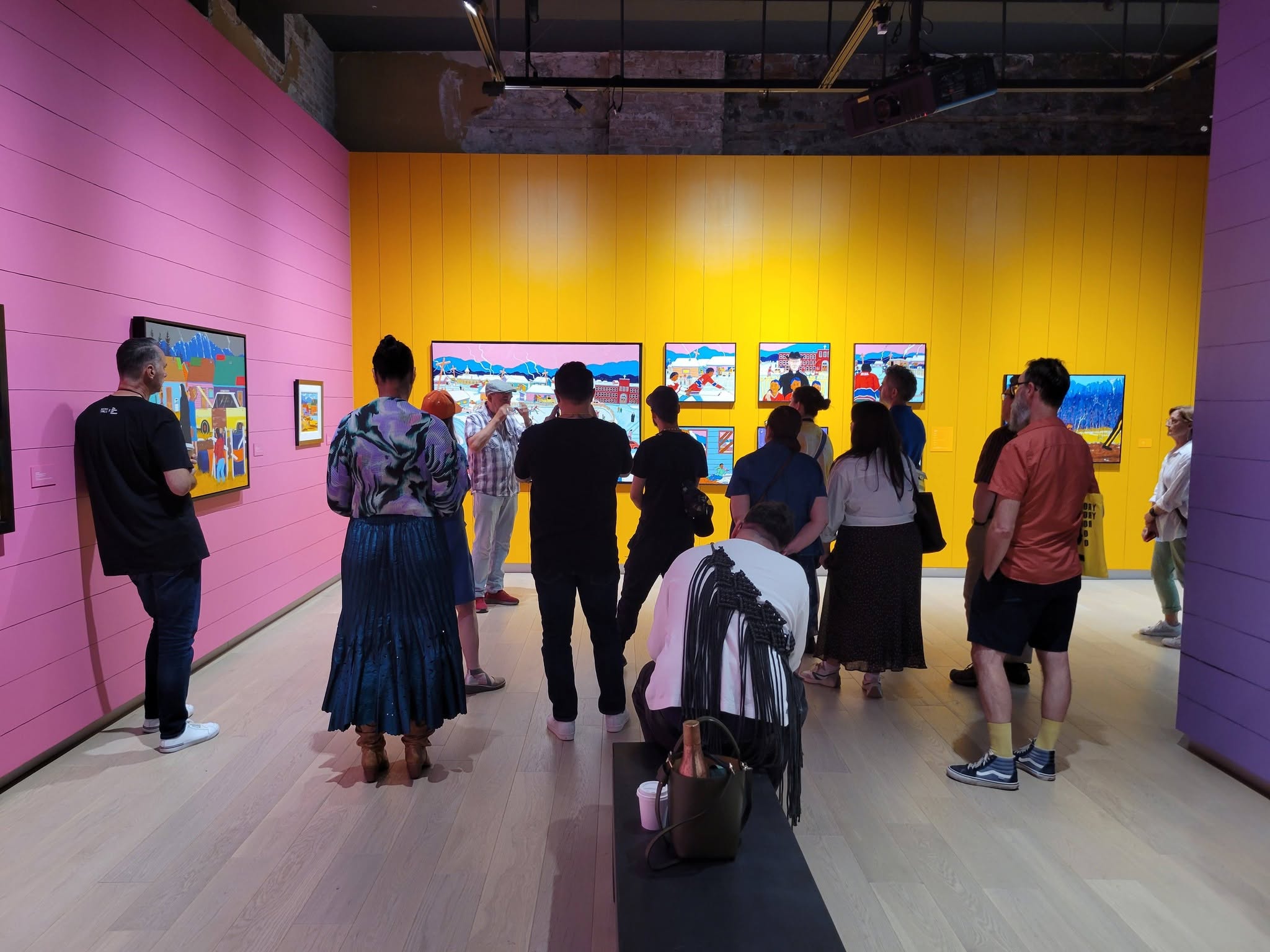
Requiems: Jim Logan @ SAW Centre. Photography Credit: Liz Barron
Papa Logan
On day three or four, the ICCA organised a tour of Jim Logan’s work at SAW Gallery, led by the legend himself.
As an island girl drawn to colour, I am immediately magnetised to Logan’s vibrant works. Joyful, candy-coloured pinks, blues, reds and whites beckon me like a bee to a flower, toward the various scenes painted by Logan of reservation life. Look closer though and the colourful, somewhat cartoonish works portray the dark histories experienced by indigenous peoples living on reservation, protagonised by a white priest in church garb.
Walk through to the back of the gallery and the transition from colour to darkness is immediate. In these darker, black-and-white, abstract, almost demonic portraits of the priest protagonist, Logan recounts the abuse and murder of thousands of Indigenous children in residential schools-many still lying in unmarked graves.
In 2018, the New Zealand Royal Commission undertook the largest independent inquiry into historical abuse in state care and care in faith-based institutions, including schools. The inquiry found that more than 200,000 children, most of them Māori and Pacific, were abused in state care. A number so staggering, so frightening, that the intergenerational impacts of colonial violence cannot be overstated.
Visiting Papa Logan’s exhibition, I am reminded that the colonial project is a playbook repeated, synchronised and methodical across Indigenous whenua the world over. Our artistry is thus a medium for ensuring our histories, experiences and truths are never forgotten.
Hutia te rito
Hutia te rito o te harakeke
Kei hea te kõmako e kō?
Kī mai ki ahau
He aha te mea nui?
He aha te mea nui o te ao?
Māku e kī atu
He tamariki! He tamariki! He tamariki!
If you remove the heart
of the flax bush,
from where will the bellbird sing?
If you say to me,
what is the most important thing
in this world,
I will reply:
it is children, it is children,
it is children!
Onáket meets Waka
Greg Hill is a Mohawk multidisciplinary artist and curator whose practice explores the tensions of settler colonialism, nationalism and concepts of place, drawing on his mixed French and Kanyen’keháka ancestry³.
In 2005, Hill removed a canoe he had created from cereal boxes from his exhibition at Ottawa Gallery and portaged it through the Rideau Centre, paddling on the Ottawa River to Askinabka Island. The performance responded to questions about the flotability of Hill’s “canoe”, and whether a vessel made from an unexpected material such as cereal boxes is still a canoe if it cannot float.
Fortunately, that day it did and the 2005 performance solidified Hill’s practice in Canadian art history.
I didn’t know Hill’s work, or his famed cereal-box canoe, before coming to Turtle Island. Our itinerary outlined that we would witness Hill perform a variation of his 2005 performance: this time portaging his canoe, Onáket, from Ottawa Gallery to Gallery 101-a 3.6-kilometre walk in peak summer.
What we didn’t know was that the performance, titled Onáket meets Waka, had been conceived specifically to coincide with our delegation’s visit to Turtle Island.
The performance and three-day exhibition acknowledged the waterways, territories and relationships that connect Indigenous peoples to one another and to place. Through performance and ceremony, Onáket meets Waka became a gesture of welcome to our delegation and a ritual opening of Indigenous exchange.
We were honoured and deeply humbled by this moving work and ceremony.
Ki a koutou ko Greg, ko ICCA, ko Ottawa Gallery, ko Gallery 101 me te tangata whenua, е mihi atu ana ki a koutou i tēnei whakaaturanga me te manaaki mai i a mātou, i a mātou e noho ana i Turtle Island.
He hono te tangata e kore e motu; ka på he taura waka e motu.
Mauri ora!
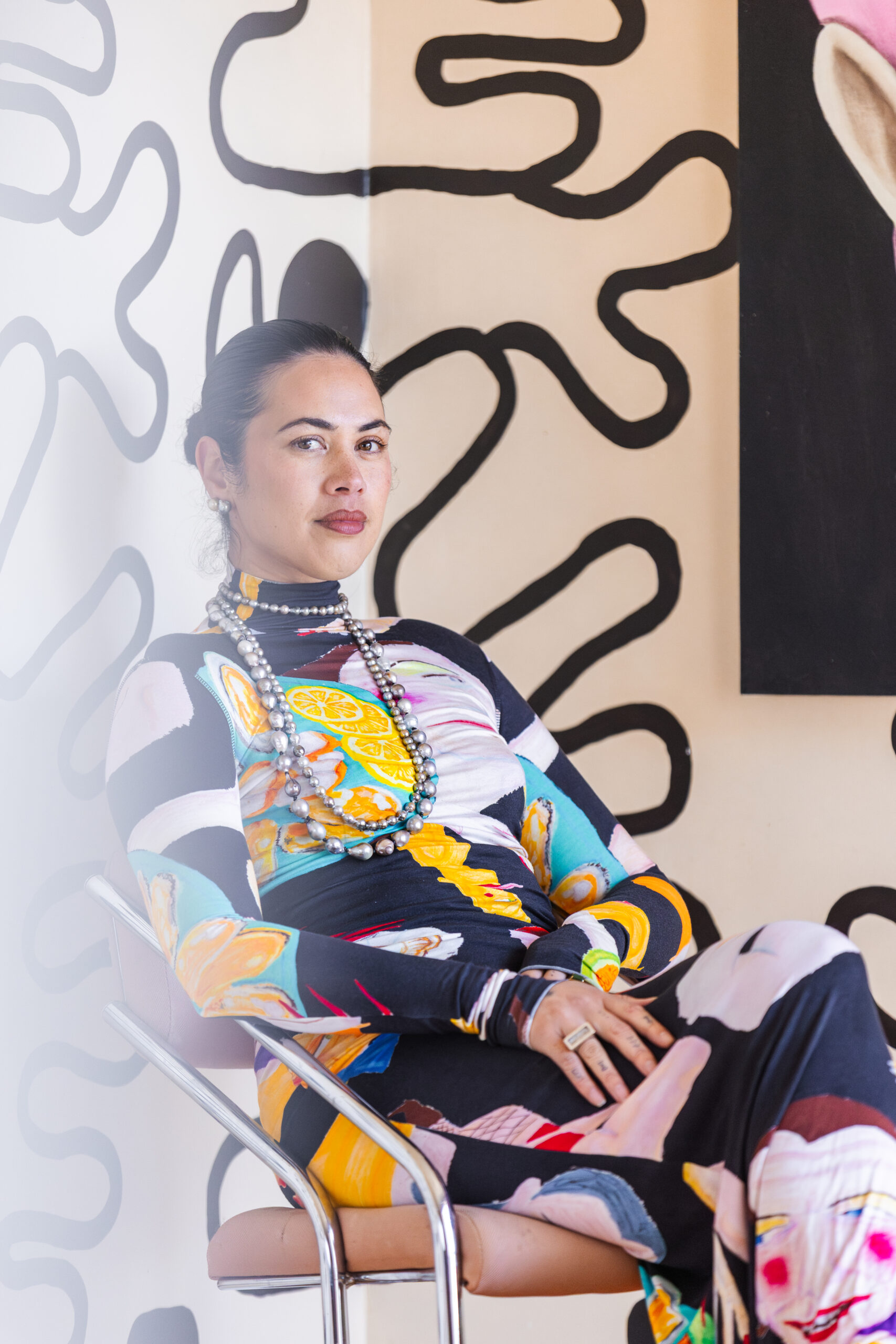
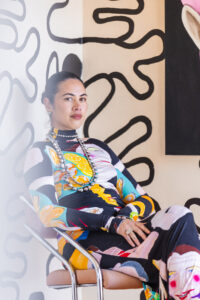 Tehani Buchanan-Whaipooti (Ngāti Rupe Makea ki Rarotonga, Ngāti Pitiaua ki Aitutaki, Nukuroa, Kōtirana) is a māmā, independent curator, artist, systems changemaker and educator. Her creative practice spans interior design, creative direction, curation, installation, Cook Islands quilt making (tīvaivai) and writing.
Grounded in her indigeneity, Tehani’s work explores indigenous reclamation, constitutional transformation from a Te Tiriti o Waitangi and Pacific perspective and the integral relationship that mahi toi (art) has in resistance movements and global conscientisation. Her recent curatorial work include guest curator at Enjoy Contemporary Art Space for the off-site exhibition, Tipurepure au Va’ine and co-curation of a follow up exhibition of the same name at Pātaka Art + Museum, where she also showed new work.
Tehani lives in Parirua on Ngāti Toa Rangatira land with her fiancé Julia and their three tamariki.
The curatorial essays presented as part of Tides & Currents: Birchbark Meets Waka are supported by the Indigenous Curatorial Collective / Collectif des commissaires autochtones (ICCA) through its International Delegation Program, in partnership with the Pātaka Foundation and supported by Creative New Zealand. This initiative fosters global exchange and mentorship between Indigenous curators, artists, and cultural leaders across Turtle Island and Aotearoa New Zealand, encouraging international collaboration, institutional engagement, and critical writing rooted in Indigenous methodologies. Through Tides & Currents, participants co-developed critical responses, reflective essays, and artistic dialogues that honor intergenerational knowledge, cultural continuity, and the transformative curatorial practices shaping the future of global Indigenous contemporary art.
Share This Article

Written by : Publications
Follow Us on Social Media
Join our Membership
September 22, 2026
September 22, 2026